Meteorological environment monitoring equipment supplier
Insist on doing high-precision customer favorite technology products

Meteorological environment monitoring equipment supplier
Insist on doing high-precision customer favorite technology products

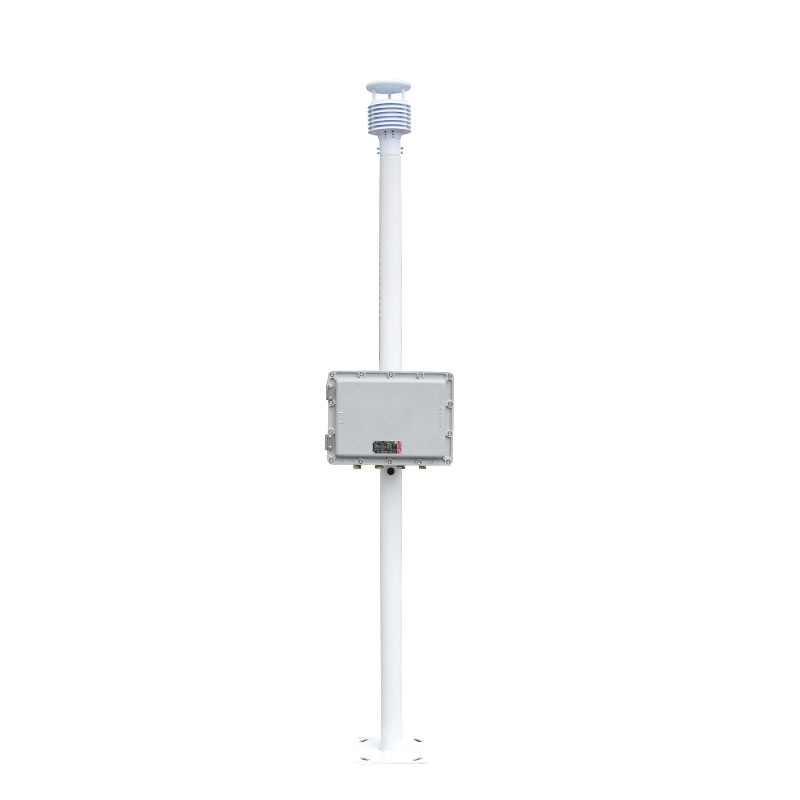
Explosion-proof weather stations employ a five-proof high-protection design, integrating sensors for wind speed and direction, temperature and humidity, and atmospheric pressure. The manufacturer holds an Ex ia IIC T6 Ga explosion-proof certificate, meeting the meteorological monitoring needs of high-risk environments such as chemical plants, oil depots, tunnels, and mines.
Explosion-proof weather stations are specifically designed for hazardous environments such as chemical plants, oil depots, tunnels, and mines where flammable and explosive gases or dust exist. They are used to collect five basic meteorological elements in real time: wind speed, wind direction, air temperature, air humidity, and atmospheric pressure, providing crucial data support for safe production in high-risk locations. Ordinary meteorological monitoring equipment operating in areas such as chemical industrial parks and oil and gas storage tank clusters may trigger explosions due to electrical sparks or mechanical friction. Therefore, explosion-proof weather stations adopt a special safety approach from the design stage.
At the physical protection level, explosion-proof weather stations employ a five-proof design concept, integrating multiple protective measures: corrosion resistance, explosion resistance, waterproofing, shock resistance, and dust resistance. The sensor housing is made of ASA material, which has good corrosion resistance and oxidation resistance, effectively resisting the corrosion of acid and alkali mists in chemical plant areas and the dust interference in mining environments. The concealed ultrasonic probe structure on the top cover effectively avoids interference from rain and snow accumulation, while eliminating the electrostatic risks that may arise from the rotational friction of traditional mechanical anemometers. The ultrasonic measurement principle utilizes continuous frequency conversion signals to detect wind speed and direction through relative phase, without relying on mechanical moving parts, thus eliminating the safety hazards caused by wear and friction at the physical level.
The core safety guarantee of the explosion-proof weather station comes from its rigorous circuit design. The equipment adopts a composite explosion-proof structure combining intrinsically safe circuitry and an explosion-proof enclosure. The circuit system uses components such as current-limiting resistors and safety barriers to control the energy of electrical sparks below a safe threshold, ensuring that even in the event of a short circuit due to a circuit failure, no energy sufficient to ignite surrounding flammable gases will be generated. Key components are independently encapsulated within the explosion-proof cavity, confining any potential sparks and high temperatures inside the equipment and preventing them from leaking out. The manufacturer possesses an Ex ia IIC T6 Ga high-level explosion-proof certificate. The T6 temperature class means the maximum surface temperature of the equipment is controlled below 85℃, making it safe for use in Zone 0 environments where flammable gases such as acetylene exist and where there is a continuous explosive hazard. The entire unit has passed the national GB3836.1-2010 and GB3836.4-2010 explosion-proof standard certifications, and its circuit design and material selection fully comply with the safety access requirements for high-risk locations.
In practical applications, the explosion-proof weather station integrates a five-element sensor that can simultaneously monitor wind speed, wind direction, temperature, humidity, and atmospheric pressure. Wind speed measurement range is 0 to 60 meters per second with an accuracy controlled within ±0.1 meters per second; wind direction measurement accuracy is ±2 degrees Celsius; temperature measurement range covers -40 to 80 degrees Celsius; and atmospheric pressure measurement range is 300 to 1100 hPa. The entire unit consumes approximately 2 watts and can operate continuously using conventional mains power. After data acquisition, the system can directly connect to the PLC or DCS system in the factory's central control room via RS485 interface and standard Modbus-RTU protocol, enabling real-time uploading and centralized management of meteorological data. Some devices can also be equipped with a 4G wireless transmission module to synchronize data to a cloud service platform, supporting remote viewing and analysis. The explosion-proof weather station also has the capacity to store no less than 500,000 local data entries, effectively preserving monitoring records and ensuring data continuity even in the event of network interruption. This technical approach, which deeply integrates high-protection-level physical design with intrinsically safe circuit design, provides reliable technical support for meteorological monitoring in high-risk industrial production environments.
Sales Manager:Ms. Emily Wang
Tel, Whatsapp:+86 15898932201
Email:info@fengtutec.com
Add:No. 155 Optoelectronic Industry Accelerator, Gaoxin District, Weifang, Shandong, China