Meteorological environment monitoring equipment supplier
Insist on doing high-precision customer favorite technology products

Meteorological environment monitoring equipment supplier
Insist on doing high-precision customer favorite technology products

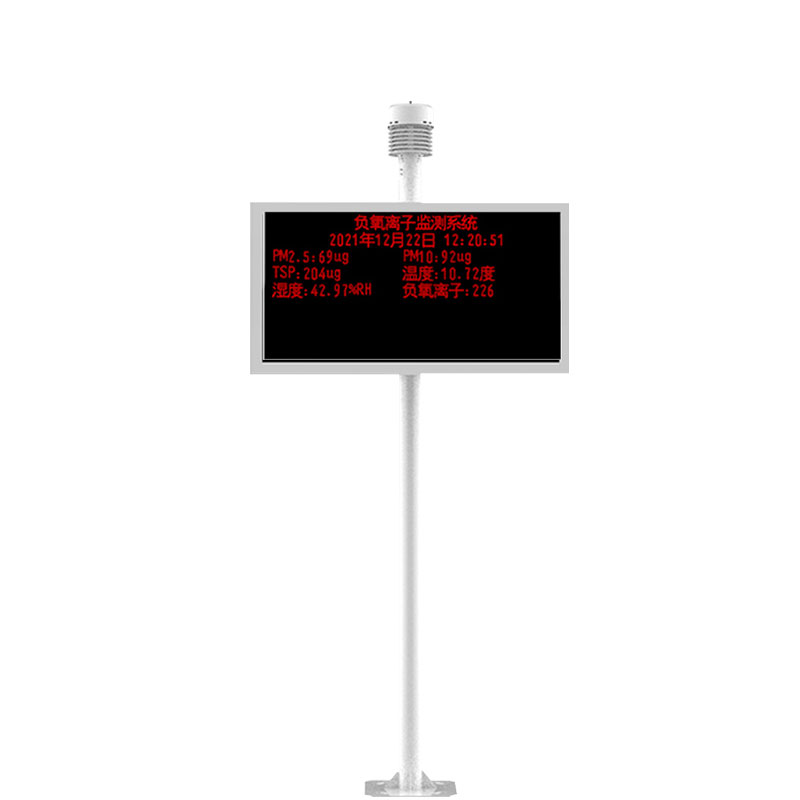
Park weather station is a specialized device designed for the continuous, all-weather detection of negative oxygen ion concentrations in the air. It is widely utilized across various sectors, including environmental protection, meteorology, forestry, tourism, scenic area management, industrial parks, and wellness centers. Depending on user requirements, the device can be expanded to monitor additional meteorological parameters—such as air temperature, humidity, PM2.5, and PM10—while its modular architecture allows for the independent replacement of individual sensors. Data can be read directly on-site via an LED screen or viewed in real-time through a remote cloud platform, web interface, or WeChat Official Account, facilitating convenient long-term operation and maintenance.
The primary function of Park weather station is to measure the concentration of negative oxygen ions in the air. Negative oxygen ion concentration serves as a crucial indicator of air quality; a higher concentration signifies fresher, cleaner air. This type of equipment is extensively deployed in settings such as environmental monitoring stations, meteorological observatories, forestry reserves, tourist attractions, industrial zones, and wellness retreats, providing a scientific basis for ecological environment assessment and health management.
Park weather station employs two primary technical principles. The first is the capacitive suction method: a specific polarization voltage is applied to the polarization plates of the ion sensor, while the air under analysis flows through the sensor at a constant velocity. Under the influence of the electric field, specific negative ions with small particle sizes undergo deflection, generating a faint electrical signal that is subsequently amplified and converted into a negative ion concentration value. The second method is coaxial double-cylinder technology, which utilizes a cylindrical capacitor structure to capture atmospheric negative ions, followed by precise statistical calculation. Instruments utilizing either of these technologies offer distinct advantages, including stable measurement processes, rapid response times, and highly accurate results.
In terms of functional design, Park weather station offers expandability to accommodate additional monitoring parameters based on user needs. These include various meteorological factors such as air temperature, humidity, PM2.5, PM10, atmospheric pressure, oxygen content, noise levels, wind speed, and wind direction. The modular structural design allows for the independent replacement of individual sensors, thereby reducing long-term operational and maintenance costs. The device comes equipped with a professional mounting bracket; it is generally recommended to install the unit at a height of 1.2 to 2 meters above the ground—approximately corresponding to the average human breathing zone—to ensure that the collected monitoring data holds greater practical significance. Data can be read directly on-site via an LED screen, while simultaneous support for remote cloud platforms, web interfaces, and WeChat Official Accounts enables continuous, automated, 24-hour monitoring. Market demand for Park weather station continues to grow. According to research data on the eco-tourism and wellness industry, the domestic procurement volume for Park weather station is projected to increase by 20.7% year-on-year in 2025, driven by continuously expanding demand within forest wellness and urban park settings. By 2025, the market size for this product category is expected to reach 2.35 billion RMB—a 32% year-on-year increase—with wellness real estate and environmental monitoring requirements serving as the core drivers of this growth. At the local government level, regions such as Pingquan in Hebei and Anji in Zhejiang are utilizing fiscal subsidies to promote the widespread adoption of monitoring equipment; consequently, the coverage rate of monitoring systems within domestic scenic areas is expected to exceed 60% by 2026. Against the backdrop of carbon neutrality goals, research establishing the correlation between negative oxygen ion concentrations and vegetation carbon sequestration capacity has positioned Park weather station as a vital tool for quantifying ecological value. As efforts in ecological environmental protection and the development of the wellness industry continue to advance, Park weather station is poised to find application in an ever-expanding range of scenarios.
Sales Manager:Ms. Emily Wang
Tel, Whatsapp:+86 15898932201
Email:info@fengtutec.com
Add:No. 155 Optoelectronic Industry Accelerator, Gaoxin District, Weifang, Shandong, China