Meteorological environment monitoring equipment supplier
Insist on doing high-precision customer favorite technology products

Meteorological environment monitoring equipment supplier
Insist on doing high-precision customer favorite technology products

Every day, students utilize Campus Weather Station to record data such as temperature, humidity, and wind speed. By integrating these activities into statistical analysis exercises in science classes and descriptive writing practice in language arts classes, meteorological knowledge is transformed from abstract textbook concepts into tangible, real-world observations.
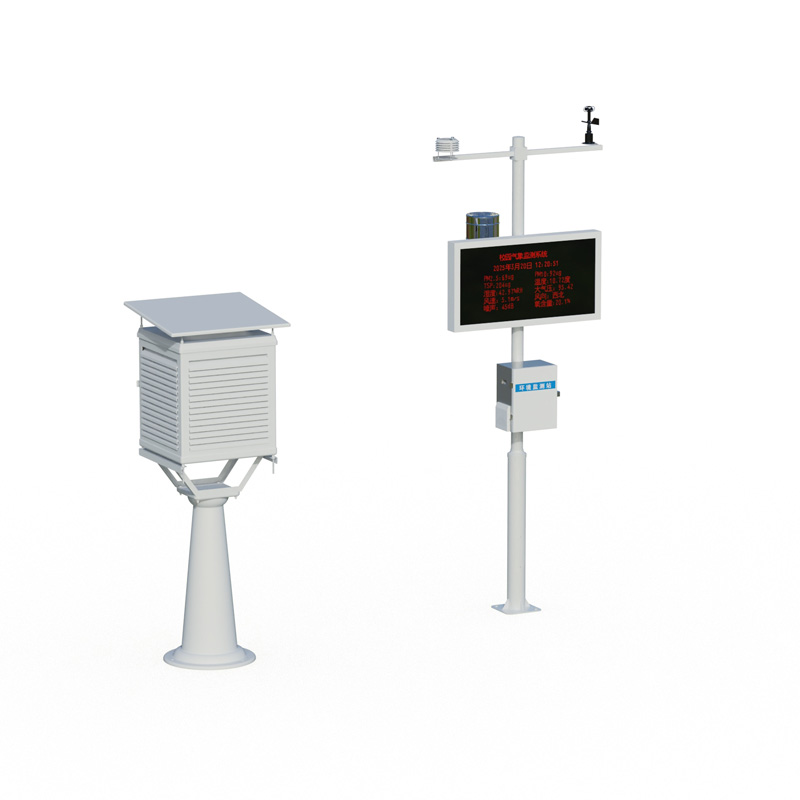
On the playground of Xincheng Primary School in Tongan District, Xiamen City, a white column stands quietly, its wind vane rotating gently atop in the breeze. During recess, several students—clutching their observation notebooks—approach the column, open the door of the white louvered instrument shelter, and carefully record the readings from the dry-bulb and wet-bulb thermometers housed inside. This setup constitutes an automated meteorological observation station, commissioned by the school in 2022. It features temperature and humidity sensors, an anemometer and wind vane, and a barometer, with data transmitted in real-time to an LED screen located in the classroom.
The core value of Campus Weather Station lies not merely in the equipment itself, but in the opportunity it affords students to personally collect and analyze authentic meteorological data. At Ruyue Lake Experimental Primary School in Ganjiang New Area, third-grade students began by crafting rain gauges out of plastic water bottles. They gradually learned that site selection requires considering open spaces and access to power sources, eventually proceeding to manually bury ground cages, pour concrete foundations, and install the instrument shelter and wind vane—thereby constructing a meteorological station unique to their own class. Throughout this process, students not only mastered observation techniques but also gained an understanding of how sensor placement impacts data accuracy.
At Urumqi No. 35 Primary School, students check the temperature and humidity data inside the instrument shelter at scheduled times each day; working in pairs, they measure wind speed and direction, subsequently compiling their observations into a class meteorological log. The school has also compiled a proprietary curriculum guide titled *Exploring Campus Meteorology*, covering topics ranging from basic meteorological principles to the mechanics of weather forecasting. Similar initiatives are underway at Nanpu Primary School in Fenghua, Zhejiang Province, where the school has developed a *Campus Meteorological Observation Manual*. This 42-period curriculum engages all students from grades three through six, who utilize their meteorological observation data for statistical analysis in science classes and for descriptive writing exercises regarding the traditional solar terms in their language arts classes.
The establishment of Campus Weather Station projects typically requires collaboration between the school and local meteorological authorities. The meteorological department provides the necessary equipment and technical support, while the school assumes responsibility for the physical site and day-to-day management of the facility. Following multiple on-site inspections conducted jointly by Jinxi Primary School in Huaihua City and the Huaihua Meteorological Bureau, a specific area within the campus—characterized by an unobstructed view and a lack of surrounding barriers—was selected as the site for a meteorological station. The Meteorological Bureau further donated several sets of professional equipment, including a Stevenson screen, an anemometer and wind vane, and a rain gauge. This collaborative approach lowered the technical barriers associated with independent procurement and installation for the school, while simultaneously ensuring that the equipment met professional standards for meteorological observation.
Regarding site selection, a meteorological station must be situated in an open area, free from the obstruction of surrounding buildings or trees, to ensure the accuracy of wind direction and temperature data. During the site selection process, students at Ruyue Lake Experimental Primary School in the Ganjiang New Area discovered that a lawn near the cafeteria—though not located in the exact geographical center of the campus—offered ample open space, was situated close to a power source, and allowed students to make observations conveniently as they passed by daily; it ultimately proved to be the most suitable choice. This process in itself became a valuable learning experience, enabling students to grasp the balance between ideal conditions and real-world constraints.
Campus Weather Station transforms abstract meteorological concepts into concrete, observable, and recordable phenomena, thereby providing authentic instructional materials for science classes. Through daily observations, data comparison, and weather reporting activities, students gradually cultivate a conscious habit of observing natural phenomena while mastering fundamental methods of data collection and analysis. This educational chain—extending from equipment to practice, and from the classroom to the outdoors—is now being successfully implemented in an increasing number of schools.
Sales Manager:Ms. Emily Wang
Tel, Whatsapp:+86 15898932201
Email:info@fengtutec.com
Add:No. 155 Optoelectronic Industry Accelerator, Gaoxin District, Weifang, Shandong, China