Meteorological environment monitoring equipment supplier
Insist on doing high-precision customer favorite technology products

Meteorological environment monitoring equipment supplier
Insist on doing high-precision customer favorite technology products

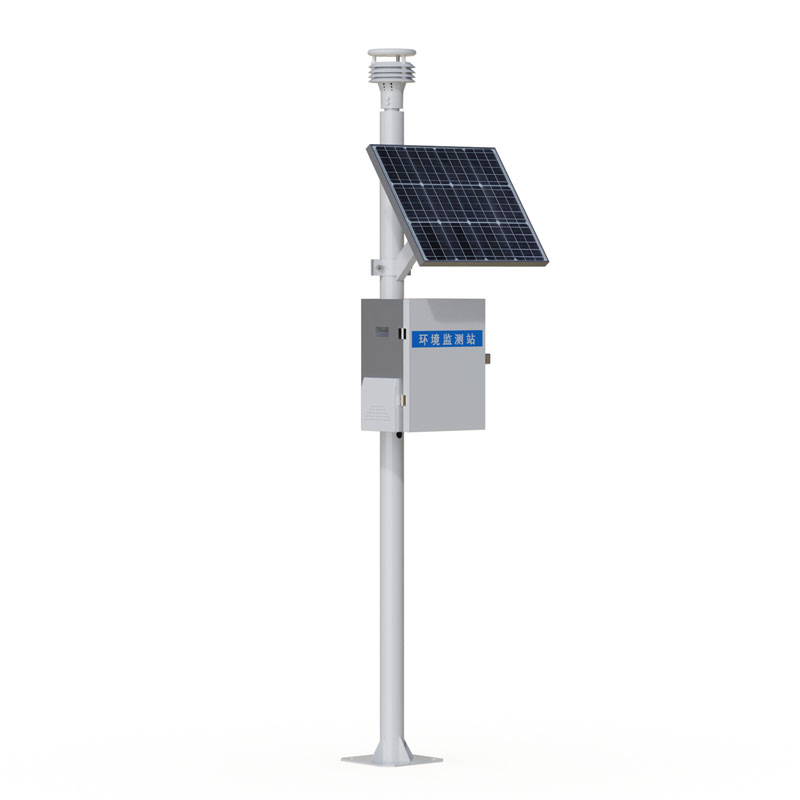
weather monitoring system employs a five-element integrated sensor, enabling real-time observation of wind speed, wind direction, temperature, humidity, and air pressure. It supports solar power and wireless data transmission, making it suitable for long-term continuous monitoring in unattended field scenarios.
weather monitoring system is a highly integrated automatic meteorological observation device, composed of sensor units, a data acquisition unit, a power supply system, and a software platform. It is used for 24-hour continuous online monitoring of outdoor meteorological parameters. The system uses a five-element integrated sensor design, integrating the measurement functions of five core meteorological elements: wind speed, wind direction, temperature, humidity, and air pressure. The sensor is based on ultrasonic measurement principles and has no mechanical rotating parts, fundamentally eliminating the mechanical wear and jamming problems caused by long-term operation of traditional anemometers. Compared to traditional weather stations that require the separate installation of multiple sensors, the integrated structure greatly simplifies the installation process; users can simply unpack the device and fix it to the pole support to begin data collection.
In terms of measurement principle, the weather monitoring system ultrasonic anemometer transmits continuously variable frequency ultrasonic signals and measures the time difference in signal transmission between probes to synthesize wind speed and direction data. Temperature measurement uses the diode junction voltage method, humidity measurement uses capacitive sensing technology, and air pressure measurement uses a piezoresistive sensor. All measured parameters are output to the data acquisition unit via a digital communication interface. The sensor housing is made of imported ASA material with a protection rating of IP65 or higher, possessing resistance to salt spray, ultraviolet radiation, and corrosion, enabling it to adapt to diverse environmental conditions from coastal ports to desert regions.
Power consumption control and power supply design determine whether the system can operate independently in the field for extended periods. The weather monitoring system has a static power consumption of less than 1 mA, which can be further reduced at night or at low data acquisition frequencies. The equipment comes standard with a solar power system, including photovoltaic panels and lead-acid or lithium battery packs, supporting MPPT automatic power point tracking to improve charging efficiency. Under continuous cloudy or rainy weather conditions, the battery pack can maintain normal system operation for several days without the need for external mains power or frequent battery replacements. Data is uploaded to the cloud platform via GPRS, 4G, LoRa, or BeiDou short message service. Users can remotely view real-time data and historical curves via computer or mobile phone. The system also supports SMS alarms for exceeding limits.
In terms of application scenarios, weather monitoring system is widely used in agricultural production for field microclimate monitoring, forestry fire prevention meteorological observation, environmental atmospheric monitoring, campus meteorological science education, and traffic meteorological early warning. In agriculture, the system continuously monitors air temperature, humidity, wind speed, and wind direction, providing data for precision irrigation, ventilation control, and pest and disease early warning. In ecological protection, meteorological stations deployed in wetlands and forests record regional microclimate characteristics, supporting the assessment of ecological restoration effects and climate change research. In disaster early warning, the system monitors wind speed and precipitation changes in real time, automatically issuing alarms before extreme weather arrives, buying time for emergency response. The five-element weather monitoring system system, through integrated sensors and a low-power, unattended design, provides a reliable long-term data acquisition solution for various meteorological observation scenarios.
Sales Manager:Ms. Emily Wang
Tel, Whatsapp:+86 15898932201
Email:info@fengtutec.com
Add:No. 155 Optoelectronic Industry Accelerator, Gaoxin District, Weifang, Shandong, China