Meteorological environment monitoring equipment supplier
Insist on doing high-precision customer favorite technology products

Meteorological environment monitoring equipment supplier
Insist on doing high-precision customer favorite technology products

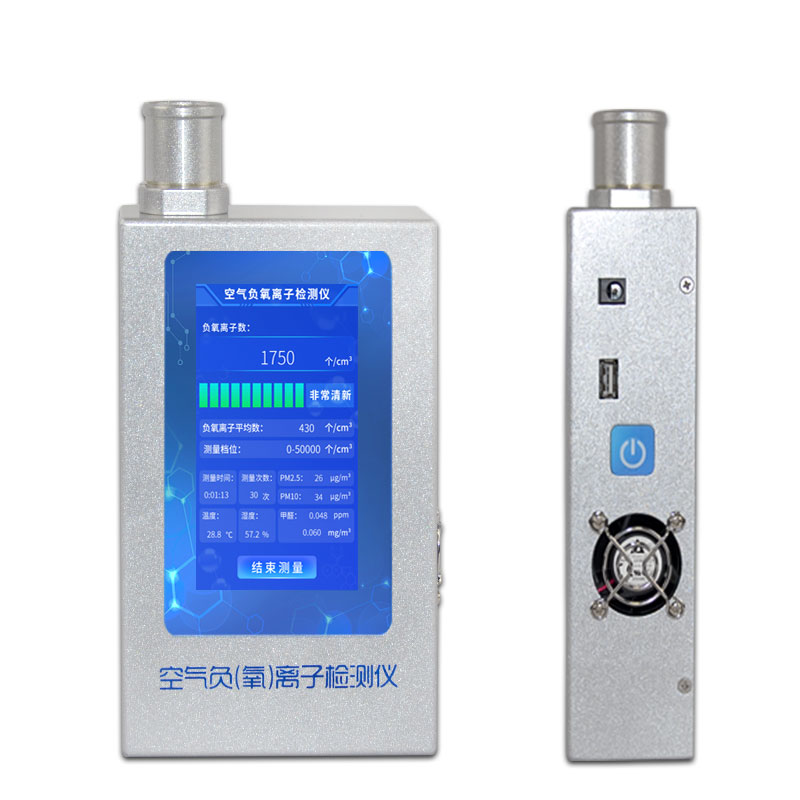
Negative ion detector employs a cylindrical capacitor structure to capture negative oxygen ions from the air, utilizing precise statistical algorithms to achieve high-accuracy measurements. The device features a compact design suitable for mobile detection across various scenarios, providing professional data support for air quality assessment.
The core technology behind Negative ion detector lies in its cylindrical capacitor structure. Through a built-in capture mechanism, this structure actively adsorbs negative oxygen ions from the air; under the influence of an electric field, these ions are deflected and collected by a collection plate. The accumulated electric charge is then processed via algorithms to calculate the ion concentration value. The entire process ensures stable measurements, rapid response times, and accurate results.
In terms of technical performance, this detector offers numerous advantages. It features a 5.0-inch capacitive touchscreen that displays measurement results in real-time. A built-in high-capacity lithium battery supports extended operation, freeing the device from power supply or location constraints—simply turn it on to begin measuring immediately. With a data refresh rate of up to once per second, the device offers highly sensitive responsiveness. The instrument is simple to operate, allowing users to quickly master its functions and complete measurements without the need for specialized training.
Regarding practical applications, Negative ion detector demonstrates broad versatility. It can be utilized for air quality monitoring in natural ecological zones—such as forests, wetlands, and scenic areas—to assess the quality of the ecological environment. In indoor settings—including offices, schools, and hospitals—it serves to detect air quality, aiding in the optimization of ventilation system operation strategies. Furthermore, it facilitates performance verification for products such as air purifiers and negative ion generators, as well as the measurement and demonstration of negative ion concentrations in fields involving nano-coatings, negative-ion-emitting home building materials, and health-oriented negative ion products.
In terms of measurement precision, the detector employs the internationally advanced cylindrical capacitor suction method. Its measurement range offers multiple selectable tiers, achieving a resolution of 1 ion/cm³ and maintaining a measurement accuracy within a margin of ±5% to ±10%. The device also boasts robust resistance to electromagnetic interference, static electricity, and radio waves; it exhibits excellent sensitivity and capture capability for small-diameter negative ions, ensuring overall stable and reliable performance.
When making a purchase, several key metrics should be prioritized. Regarding detection accuracy, priority should be given to products that possess official metrological certification. The measurement range must be tailored to the specific application scenario; for indoor environments, a smaller range suffices, whereas high-concentration settings—such as forests or near waterfalls—require instruments with a wider range. Data storage and export capabilities, as well as the user-friendliness of the display interface, are also critical factors to consider. Furthermore, the device's protection rating and battery life determine its suitability for outdoor use.
Negative ion detector leverages cylindrical capacitive capture technology and multi-scenario adaptability to provide a portable, instant-read professional solution for air quality monitoring. Whether for environmental research, eco-tourism development, or concentration regulation in health-sensitive environments, this device delivers a robust scientific data foundation.
Sales Manager:Ms. Emily Wang
Tel, Whatsapp:+86 15898932201
Email:info@fengtutec.com
Add:No. 155 Optoelectronic Industry Accelerator, Gaoxin District, Weifang, Shandong, China