Meteorological environment monitoring equipment supplier
Insist on doing high-precision customer favorite technology products

Meteorological environment monitoring equipment supplier
Insist on doing high-precision customer favorite technology products

The construction and implementation of University Weather Station requires balancing hardware configuration with teaching applications. By strategically selecting locations and installing sensors for temperature, humidity, wind speed, and wind direction, real-time campus weather monitoring can be achieved. This system not only provides precise data support for school safety management but can also be integrated into courses such as geography, becoming a practical base for students to conduct project-based learning.
In recent years, with the refinement of campus safety management and the deepening of quality education, more and more primary and secondary schools have begun to plan and build their own University Weather Station. This initiative not only enables real-time monitoring of weather changes on campus, providing accurate weather forecasts and meteorological information to various school departments and ensuring the safe and orderly conduct of campus activities, but also provides students with a practical platform to connect with nature and explore science.
To build a successful University Weather Station, scientific planning and reasonable site selection are essential. Based on the practical experience of schools in various locations, weather stations should be built in open and spacious areas on campus, avoiding obstruction by tall buildings, to ensure the accuracy of data such as wind speed, wind direction, and temperature. For example, the meteorological research park at Yueqing Middle School, after nearly twenty years of development, is equipped with a complete set of equipment, from traditional manual recording instruments to automated weather stations. Covering an area of over 300 square meters, it not only includes an observation area but also a geography classroom and a meteorological studio, forming a complete teaching and practice base. The "Little Water Drop Weather Station" at Mingxi County Chengguan Primary School is equipped with an automatic weather station for wind speed, wind direction, temperature, and precipitation, as well as a warning information dissemination terminal. Data is displayed in real-time on the campus screen.
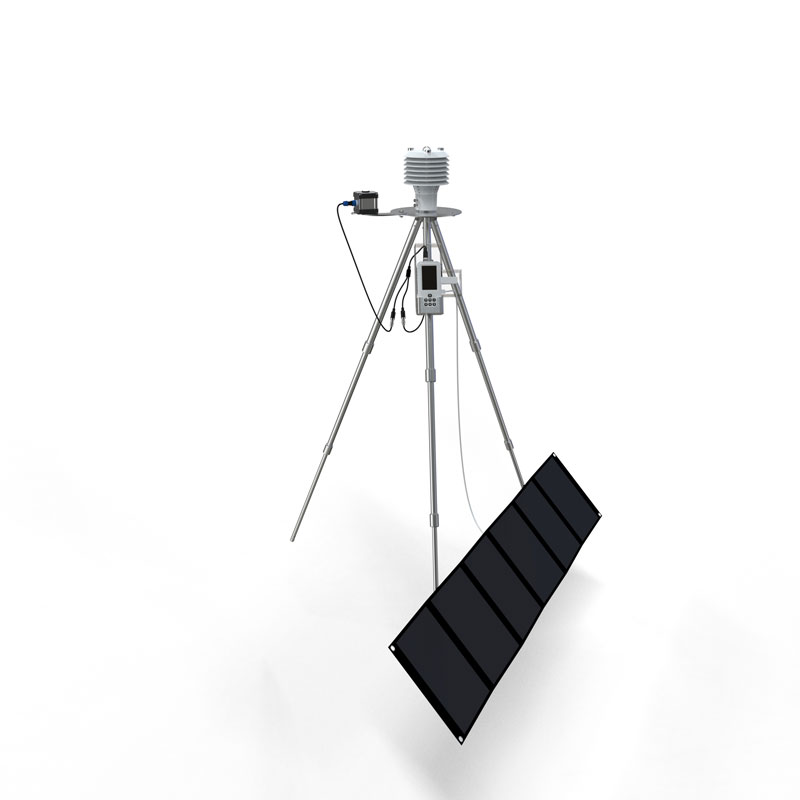
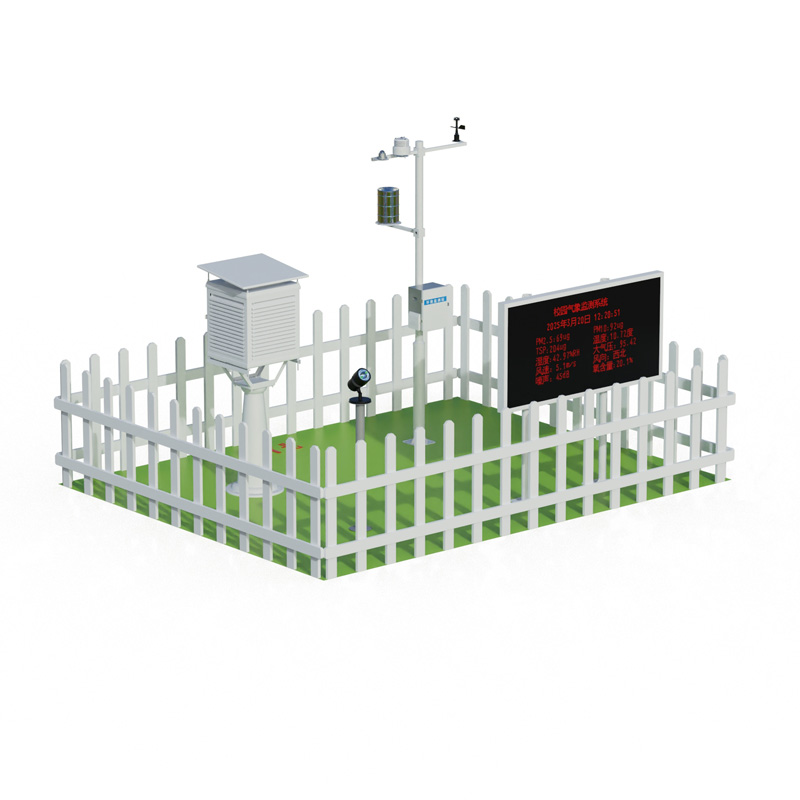
In terms of hardware configuration, modern meteorological equipment typically uses highly integrated, one-piece devices, characterized by low power consumption, rapid installation, and ease of teaching. Core sensors include ambient temperature, humidity, light intensity, atmospheric pressure, wind speed and direction, rainfall, and soil temperature and humidity. Data is transmitted in real-time to a cloud platform via GPRS or wired network, and teachers and students can view it anytime via mobile app, computer webpage, or the campus LED screen. Some schools have also introduced more professional observation projects. For example, Zhenbei Middle School's intelligent weather station combines open-source sensors to support students in data analysis and interdisciplinary inquiry; Diaozhuang Primary School has further integrated artificial intelligence, developing a "Little Meteorological Engineer" club course that uses intelligent agents to provide students with real-time data queries and learning support.
The core value of University Weather Station lies in its application. From the perspective of campus safety management, the "Campus Outdoor Activity Index" launched by the Haidian District Meteorological Bureau in conjunction with the Education Commission is a typical example. Based on the precise latitude and longitude of each school, this index extracts hourly meteorological elements from kilometer-level intelligent grid forecasts, helping schools flexibly adjust the timing of physical education classes, sports meets, and autumn outings, effectively avoiding adverse weather conditions such as strong winds and rain. This "meteorology + education" model transforms professional meteorological services into a perceptible safety guarantee for the campus.
From the perspective of teaching practice, weather stations provide students with real-world scenarios for "learning by doing." At Yueqing Middle School, students use their breaks to record ground temperature data from different underlying surfaces, conduct small-scale research projects, and even integrate meteorological observations with multiple disciplines such as physics, chemistry, and technology, achieving excellent results in national meteorological talent competitions. Students at Diaozhuang Primary School connect observational data with meteorological proverbs to understand the wisdom of ancient people regarding climate, and also use programming to call up sensor data for multi-source data comparative analysis. Students at Zhenbei Middle School use weather station data to explore the optimal conditions for outdoor cultivation of oyster mushrooms, closely integrating meteorology with bio-cultivation.
Furthermore, the implementation of University Weather Station often relies on external resource support. Many schools have established collaborative relationships with local meteorological bureaus, hiring meteorological experts as off-campus mentors to regularly conduct popular science lectures and equipment maintenance training. This cooperation ensures the professionalism of the observational data and provides teachers and students with opportunities to access cutting-edge meteorological technologies.
In conclusion, the implementation of University Weather Station is not simply a matter of equipment procurement and installation, but a systematic project encompassing site selection planning, hardware configuration, data application, and curriculum integration. When weather stations are truly integrated into daily teaching and management, they can become guardians of campus safety, incubators for scientific inquiry, and help create a smart meteorological campus.
Sales Manager:Ms. Emily Wang
Tel, Whatsapp:+86 15898932201
Email:info@fengtutec.com
Add:No. 155 Optoelectronic Industry Accelerator, Gaoxin District, Weifang, Shandong, China