Meteorological environment monitoring equipment supplier
Insist on doing high-precision customer favorite technology products

Meteorological environment monitoring equipment supplier
Insist on doing high-precision customer favorite technology products

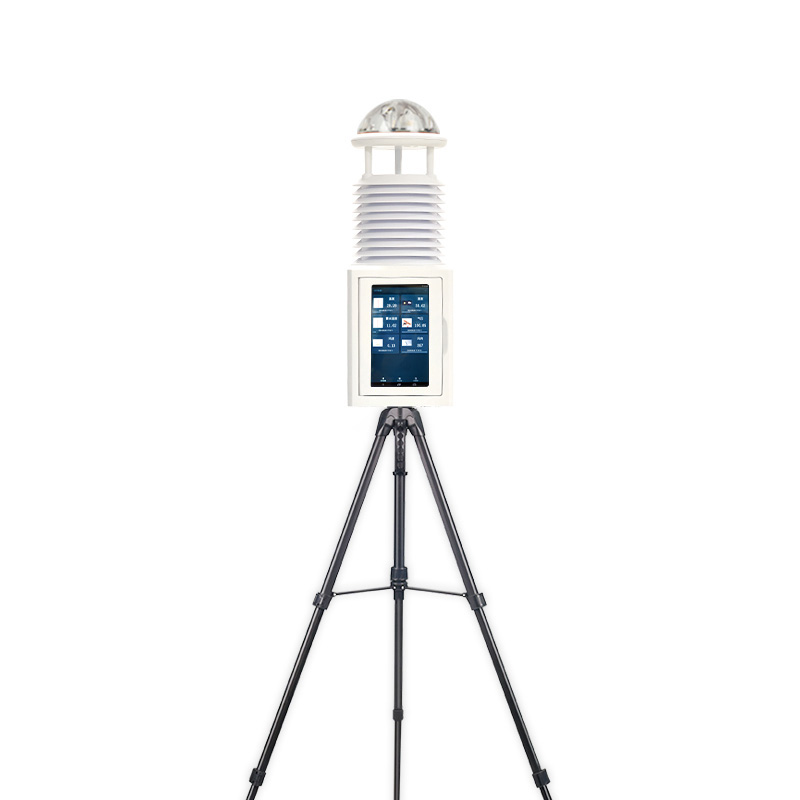
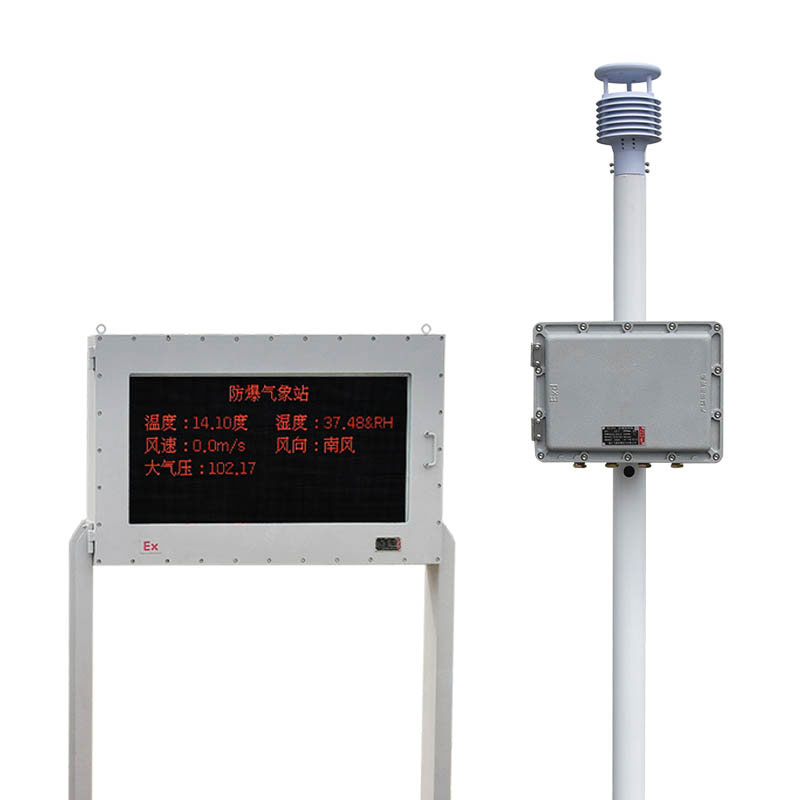
The chemical explosion-proof weather station is an integrated meteorological monitoring device designed for flammable and explosive environments such as chemical plants and oil depots. It integrates data acquisition, storage, communication, and display. The product adopts a five-proof design: corrosion-resistant, explosion-proof, waterproof, shockproof, and dustproof. Through a concealed ultrasonic probe and RS232 wired transmission, it displays real-time data on five key elements: wind speed, wind direction, temperature, humidity, and atmospheric pressure on an explosion-proof screen.
The chemical explosion-proof weather station is an integrated meteorological monitoring device designed for high-risk flammable and explosive environments such as chemical plants, oil depots, tunnels, and mines. This device integrates data acquisition, storage, communication, and display, directly displaying meteorological data in real-time on an explosion-proof screen via wired communication.
Regarding explosion-proof safety, the chemical explosion-proof weather station adopts a five-proof design concept: corrosion-resistant, explosion-proof, waterproof, shockproof, and dustproof. The sensor housing is made of ASA material, possessing corrosion resistance and oxidation resistance, and can withstand the corrosive effects of common chemical gases in chemical environments. The equipment has passed the Ex ia IIC T6 Ga high-level explosion-proof certification and complies with GB3836.1-2010 and GB3836.4-2010 explosion-proof standards.
In meteorological monitoring, the chemical explosion-proof meteorological station integrates a single sensor for five elements: wind speed, wind direction, air temperature, humidity, and atmospheric pressure. Wind speed measurement range: 0 to 60 m/s, accuracy ±0.1 m/s; wind direction measurement range: 0 to 360°, accuracy ±2°; air temperature measurement range: -40 to 80℃, accuracy ±0.3℃; humidity measurement range: 0 to 100%RH, accuracy ±3%RH; atmospheric pressure measurement range: 300 to 1100 hPa, accuracy ±0.25%. The top cover adopts a concealed ultrasonic probe design, which avoids interference from rain and snow accumulation and prevents natural wind obstruction. Its working principle is to emit continuously variable frequency ultrasonic signals and detect wind speed and direction by measuring the relative phase.
In terms of data transmission and display, the chemical explosion-proof weather station transmits monitoring data to an explosion-proof screen via an RS232 interface. The screen measures 1 meter by 0.5 meters and is composed of nine P10 unit boards. The equipment supports both PC and LED explosion-proof screen monitoring modes, adopts the standard Modbus protocol, and can interface with various backend systems. Its integrated structural design simplifies installation and disassembly. The equipment is customizable, allowing for flexible configuration of monitoring elements according to user needs. The standalone version has a data storage capacity of no less than 500,000 records and supports historical data query and analysis. The equipment consumes 202W and uses AC220V power. This weather station can meet the usage needs of chemical plants, oil depots, tunnels, mines, and other scenarios, providing meteorological data support for safe production in flammable and explosive environments.
Sales Manager:Ms. Emily Wang
Tel, Whatsapp:+86 15898932201
Email:info@fengtutec.com
Add:No. 155 Optoelectronic Industry Accelerator, Gaoxin District, Weifang, Shandong, China