Meteorological environment monitoring equipment supplier
Insist on doing high-precision customer favorite technology products

Meteorological environment monitoring equipment supplier
Insist on doing high-precision customer favorite technology products

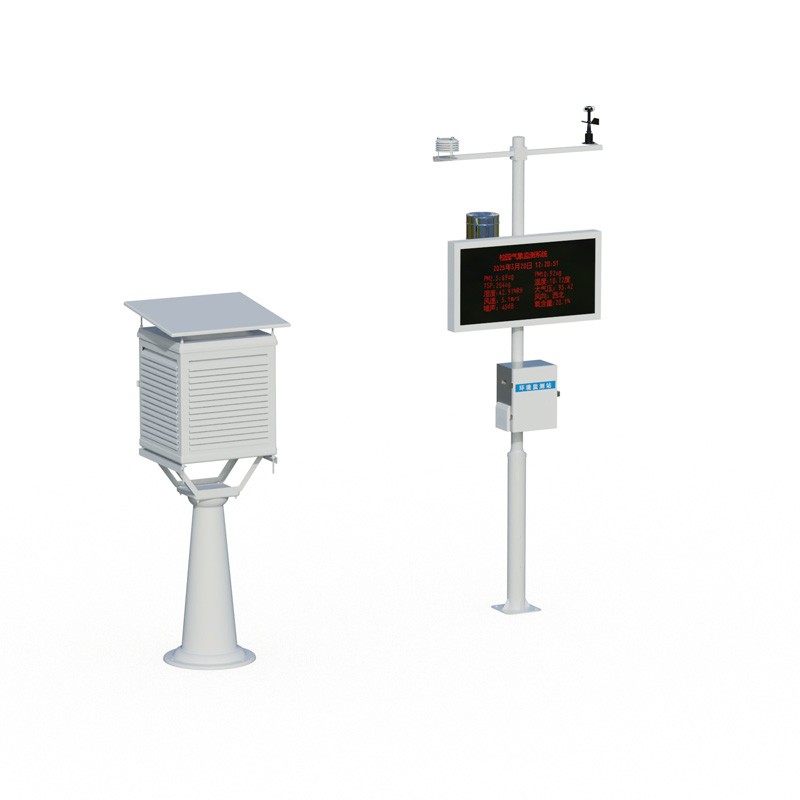
The design of a primary school weather station must address a practical need: the equipment on campus should not only allow students to interpret automatically collected data but also provide opportunities for them to engage in hands-on operation of traditional instruments. A typical weather station for primary schools is powered by the mains, transmits data via 4G or an optional wired connection, and features an LED screen to display real-time observations. The hardware includes sensors for wind speed and direction, rainfall, solar radiation, and atmospheric pressure, along with a mounting mast, an equipment enclosure, a data logger, and a cloud platform. Additionally, it incorporates a louvered screen (Stevenson screen) housing a psychrometer (dry-bulb and wet-bulb thermometers). This configuration allows automated and manual observation methods to function side-by-side, each serving distinct educational purposes.
In practice, the site selection and installation process itself can be integrated into the curriculum. Some schools involve students in site surveying and layout design, helping them realize that a weather station is not a complex structure, but rather a combination of sensors and displays mounted on a mast. The installation phase—involving foundation anchoring, conduit laying, and the calibration of the louvered screen—introduces students to fundamental engineering practices. It also helps them understand why an observation site requires an open space, and why there are specific standards for the height and spacing of instruments. According to relevant construction guidelines, a school weather observation site should ideally be a rectangular area oriented along a north-south axis, with instruments arranged in rows (east-west) and columns (north-south), spaced at least two meters apart.
Regarding curriculum integration, data from the weather station can be incorporated into various subjects. In science classes, real-time data on wind speed, wind direction, rainfall, and solar radiation can be used to explain the principles behind measuring weather elements. In mathematics, historical data can be used to create statistical charts, such as analyzing temperature fluctuations over a week or a month. In language arts, students can use their observation records to write weather diaries or prepare scripts for weather reports. Some schools have incorporated the weather station into their after-school programs, establishing "meteorology interest groups" tasked with daily data logging and campus-wide weather broadcasts, thereby turning the operation and maintenance of the equipment into a routine activity for students. Practical examples show that by comparing manual observations with readings from an automated weather station, students can gain a more intuitive understanding of the two different methods for data collection.
The inclusion of a psychrometer (dry- and wet-bulb thermometer) within a Stevenson screen is a key feature that distinguishes this design for an elementary school weather station from a purely automated system. While automated sensors provide convenient, real-time data, the psychrometer requires students to learn how to take readings and perform calculations, helping them grasp the fundamental principles of humidity measurement. For the elementary school level, a setup that combines visible, traditional instruments with invisible, electronic data collection is better aligned with pedagogical needs than a system relying on a single technological approach. The true value of a school weather station lies not in the quantity of equipment, but in whether teachers can integrate it into daily instruction and students can engage with it consistently—ensuring it functions as a practical, active scientific tool on campus.
Sales Manager:Ms. Emily Wang
Tel, Whatsapp:+86 15898932201
Email:info@fengtutec.com
Add:No. 155 Optoelectronic Industry Accelerator, Gaoxin District, Weifang, Shandong, China