Meteorological environment monitoring equipment supplier
Insist on doing high-precision customer favorite technology products

Meteorological environment monitoring equipment supplier
Insist on doing high-precision customer favorite technology products

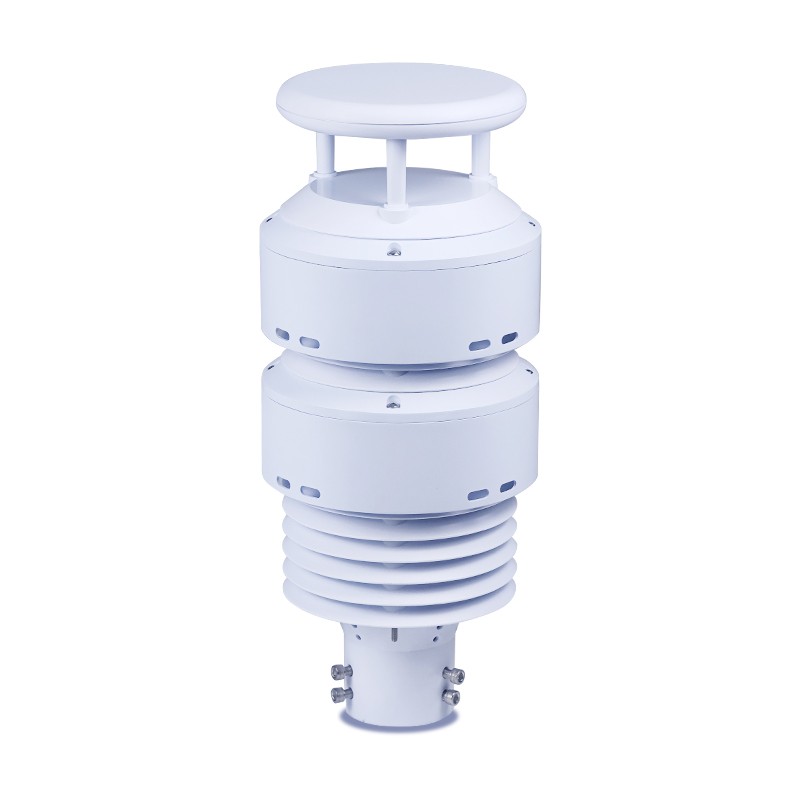
Environmental Monitoring is a monitoring device that integrates ten parameters—negative oxygen ions, PM2.5, PM10, temperature, humidity, atmospheric pressure, oxygen concentration, noise, wind speed, and wind direction—into a single, unified structure. Through this integrated design, it enables the continuous collection of outdoor meteorological data and outputs all parameters simultaneously via a digital communication interface, providing real-time data support for scenic areas, ecological parks, and environmental monitoring stations. The core value of such equipment lies in reducing the complexity of deploying multiple sensors while ensuring the synchronization and stability of the data output.
Traditional atmospheric monitoring often requires the separate installation of particulate matter sensors, meteorological modules, and gas detection units. Because these devices operate independently, they necessitate cumbersome wiring and make it difficult to align data timestamps. The integrated Environmental Monitoring combines technologies—such as light-scattering particulate detection, ultrasonic wind speed and direction measurement, capacitive temperature and humidity sensing, and electrochemical oxygen analysis—within a single housing, thereby minimizing the need for external cables and mounting brackets. The device typically utilizes an RS485 communication interface with the MODBUS protocol to support real-time data acquisition; some models also offer optional wireless transmission modules, allowing for sampling intervals of less than one minute. This structural design enables a single unit to perform synchronous collection of all ten parameters, effectively avoiding the maintenance challenges associated with distributed deployments.
In terms of environmental adaptability, Environmental Monitoring is specifically engineered for long-term outdoor operation. Its top cover features a concealed ultrasonic probe design, which helps prevent the accumulation of rain or snow from interfering with wind speed measurements. The outer casing is generally constructed from ASA engineering plastic, a material resistant to discoloration and aging caused by prolonged exposure to sunlight and temperature fluctuations. Internally, the device incorporates a watchdog circuit and an automatic reset function, ensuring continuous system operation in unattended environments. Furthermore, as the unit contains no moving mechanical parts, the sensors are not subject to wear and tear; this eliminates the need for frequent on-site calibration, thereby reducing operational and maintenance costs for remote monitoring sites. In terms of power supply, the device maintains a low typical power consumption, making it well-suited for deployment in off-grid areas when paired with a solar power system.
Regarding application scenarios, Environmental Monitoring is primarily designed for environments that require simultaneous monitoring of air quality and meteorological conditions. In ecological scenic areas and forest parks, it tracks negative oxygen ion concentrations alongside temperature and humidity data to provide visitors with insights into environmental quality. In urban settings, the device is used at environmental monitoring stations to assess the impact of particulate matter and noise levels near roadways or construction sites. In agricultural zones, it monitors oxygen levels, wind speed, and wind direction, offering valuable data to support production management. The device outputs raw measurement data, which users can then integrate into a cloud platform or a local display terminal for further processing. Its digital communication interface simplifies wiring when networking multiple units, significantly reducing the complexity of centralized data collection.
Sales Manager:Ms. Emily Wang
Tel, Whatsapp:+86 15898932201
Email:info@fengtutec.com
Add:No. 155 Optoelectronic Industry Accelerator, Gaoxin District, Weifang, Shandong, China