Meteorological environment monitoring equipment supplier
Insist on doing high-precision customer favorite technology products

Meteorological environment monitoring equipment supplier
Insist on doing high-precision customer favorite technology products

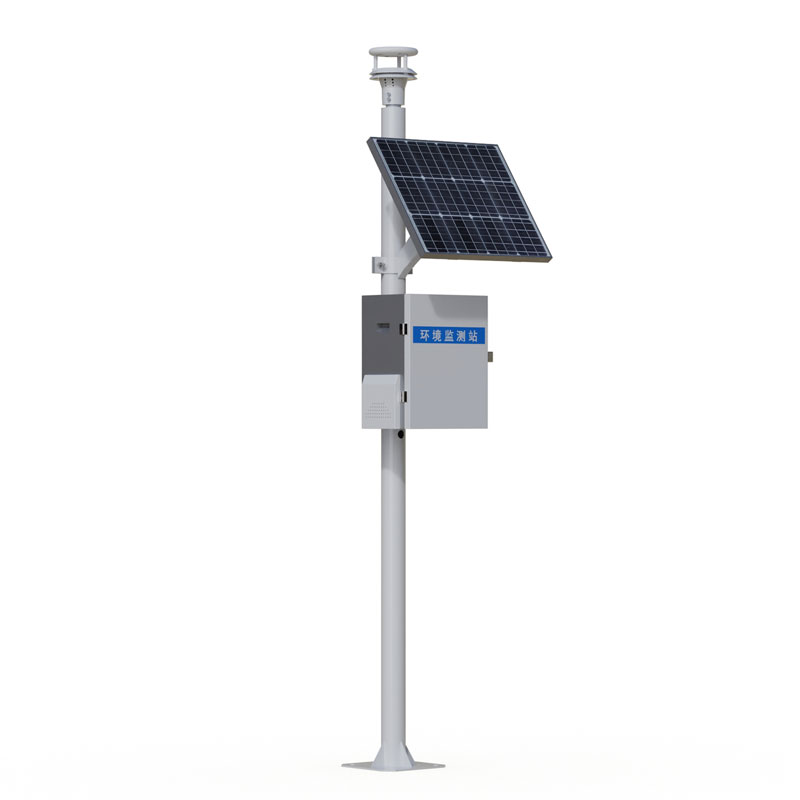
Meteorological station is a highly integrated, low-power, and quickly installable high-precision automatic meteorological observation device. This device requires no debugging and can be quickly deployed. It uses a two-element integrated sensor to observe wind speed and direction in real time, making it suitable for 24-hour continuous online monitoring in meteorology, agriculture, forestry, environmental protection, marine, airports, ports, scientific research, and school education.
Meteorological station works based on the ultrasonic time-of-flight method, calculating wind speed and direction by measuring the time difference of ultrasonic waves propagating in the air with and against the wind. The device uses four sets of ultrasonic sensor arrays to alternately transmit and receive ultrasonic pulses. The time difference between the windward and upstream directions is calculated by a microprocessor and converted into a wind speed vector and wind direction angle. The design without mechanical rotating parts avoids the mechanical wear problems of traditional wind cups and wind vanes, and also makes the device almost unrestricted by starting wind speed, enabling it to accurately capture even slight wind field changes. From a technical perspective, common models typically measure wind speed from 0 to 60 m/s, wind direction from 0 to 360° with no angle limitation, wind speed resolution up to 0.01 m/s, and wind direction resolution of 1°. Protection ratings generally reach IP65 or higher, and operating temperatures range from -40°C to 85°C, making them suitable for harsh environments such as deserts, polar regions, and oceans.
This device employs a two-element integrated sensor design, integrating wind speed and wind direction measurement units into a single housing. This enables continuous 24-hour online monitoring of outdoor meteorological parameters and outputs both parameters simultaneously via a digital communication interface. In practical deployment, the device is characterized by its no-debugging nature and rapid installation; users can put it into use without complex on-site calibration. During installation, attention should be paid to the horizontal placement of the device and the alignment with north. The installation site must meet the basic requirements of being open and unobstructed.
Meteorological station is widely used in various fields, including daily data collection at meteorological observation stations, ventilation control in agricultural greenhouses, wind field monitoring in forestry, atmospheric environmental assessment in the environmental protection field, wind field data collection from marine buoys and ships, crosswind monitoring of airport runways, safety monitoring of port and dock operations, on-site meteorological observation during scientific expeditions, and meteorological science popularization education in schools. The device's low power consumption supports solar power supply solutions, and combined with wireless data transmission capabilities, it can achieve long-term continuous operation in remote areas without mains power access.
Sales Manager:Ms. Emily Wang
Tel, Whatsapp:+86 15898932201
Email:info@fengtutec.com
Add:No. 155 Optoelectronic Industry Accelerator, Gaoxin District, Weifang, Shandong, China