Meteorological environment monitoring equipment supplier
Insist on doing high-precision customer favorite technology products

Meteorological environment monitoring equipment supplier
Insist on doing high-precision customer favorite technology products

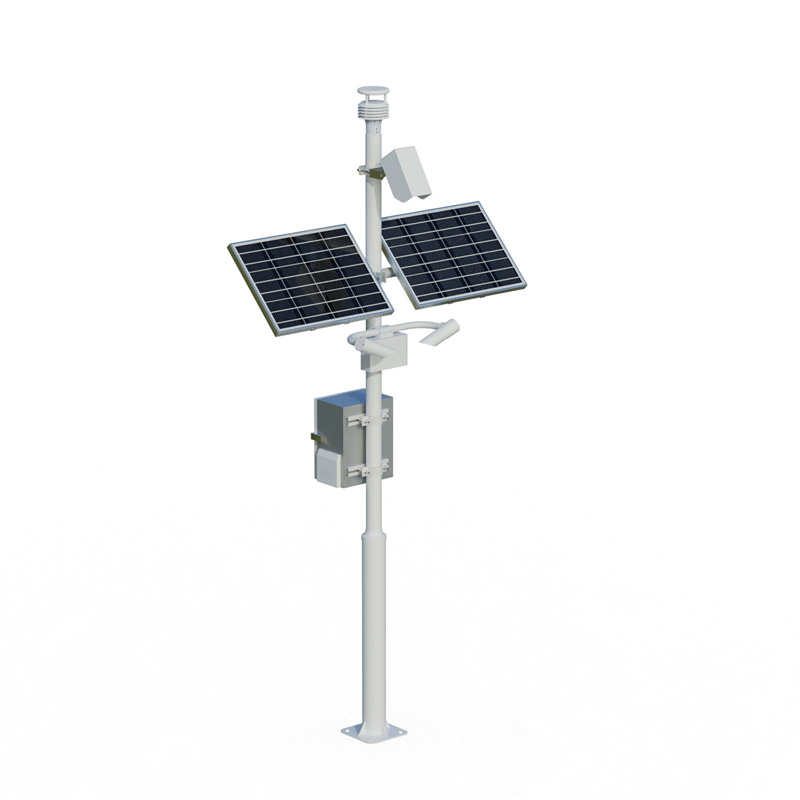
University Weather Station integrates sensors, data collectors, LED displays, and a cloud platform to establish a standardized observation system within the campus. Through real-time data collection and recording, students gain a visual and intuitive understanding of the measurement processes for meteorological elements such as temperature and wind speed.
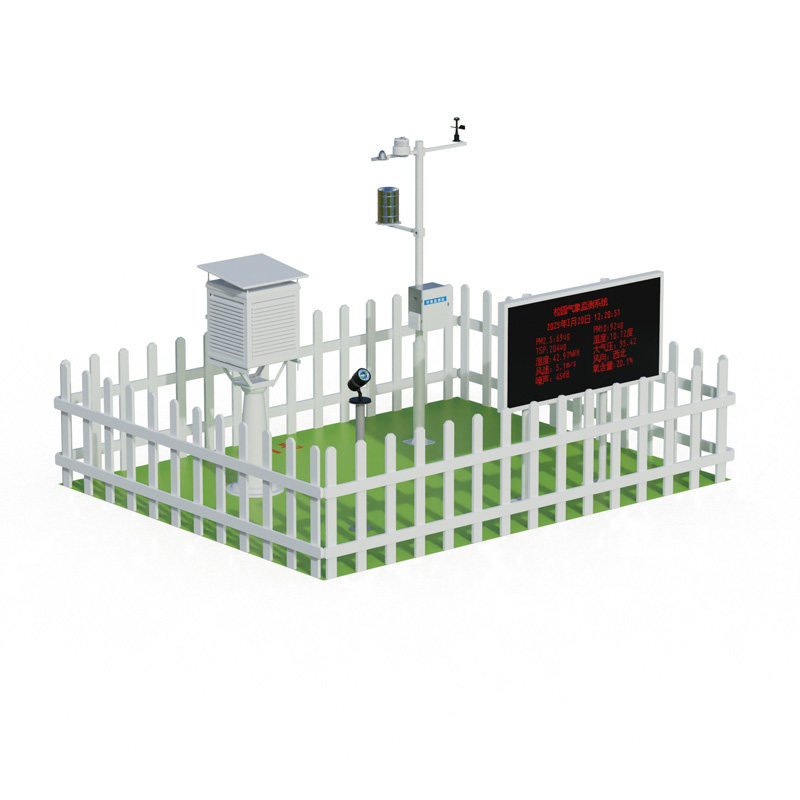
University Weather Station is a standardized meteorological observation system custom-tailored for schools. Its hardware components include sensors, mounting poles, equipment cabinets, LED displays, data collectors, a cloud platform, a fiberglass Stevenson screen (housing dry-bulb and wet-bulb thermometers), a sunshine recorder, and protective fencing. This system features a highly integrated, low-power design that allows for rapid installation and facilitates ease of use in educational settings.
Site selection is the primary step in establishing a campus meteorological station. The observation field should be situated in an open area of the campus with level ground, enclosed by a fence. The ground cover within the field should consist of a uniform layer of grass, with no crops planted; the entrance to the observation field should face north. Instrument placement adheres to the principle of "higher in the north, lower in the south": the Stevenson screen is positioned 1 meter above the ground, the rain gauge is 70 centimeters above the ground, and the anemometer is mounted atop a 10-meter pole, ensuring that data collected by each instrument remains free from mutual interference. Furthermore, the site must be kept clear of interference sources—such as tall buildings, dense foliage, outdoor air conditioning units, and exhaust vents—to prevent localized anomalies in temperature or humidity, or obstructed airflow, which could lead to data inaccuracies.
Regarding equipment configuration, the core observation zone integrates sensors for temperature, humidity, wind speed, wind direction, atmospheric pressure, and rainfall. Data is automatically collected by a data collector and transmitted to the cloud platform via wired or wireless connections. A dry-bulb and wet-bulb thermometer set is housed within the fiberglass Stevenson screen to facilitate manual cross-verification observations. A sunshine recorder is installed in an open location to capture full-day sunshine data, while an LED display continuously scrolls through and presents real-time meteorological readings, allowing teachers and students to check current conditions at any time.
The core value of the campus meteorological station lies in transforming observation equipment into educational tools. Students can participate in daily observations and data recording—analyzing the causes of monsoons in geography class, verifying gas laws in physics class, or investigating the relationship between photosynthesis and sunshine duration in biology class. Schools can establish meteorology interest groups and assign students on duty to regularly take readings and broadcast weather data, thereby integrating meteorological observation into the daily teaching curriculum. By comparing manual readings with automatically collected data, students can gain an intuitive understanding of the sources of measurement error and the significance of instrument calibration.
Furthermore, the campus weather station requires the implementation of a routine maintenance protocol—including cleaning sensors, inspecting the power supply system, and calibrating instrument accuracy—along with the designation of a dedicated individual to oversee data management, thereby ensuring the long-term, stable operation of the equipment. Ultimately, this weather station will serve as a bridge connecting classroom theory with the real-world environment, enabling students to master the fundamental methods of scientific observation through hands-on, practical engagement.
Sales Manager:Ms. Emily Wang
Tel, Whatsapp:+86 15898932201
Email:info@fengtutec.com
Add:No. 155 Optoelectronic Industry Accelerator, Gaoxin District, Weifang, Shandong, China