Meteorological environment monitoring equipment supplier
Insist on doing high-precision customer favorite technology products

Meteorological environment monitoring equipment supplier
Insist on doing high-precision customer favorite technology products

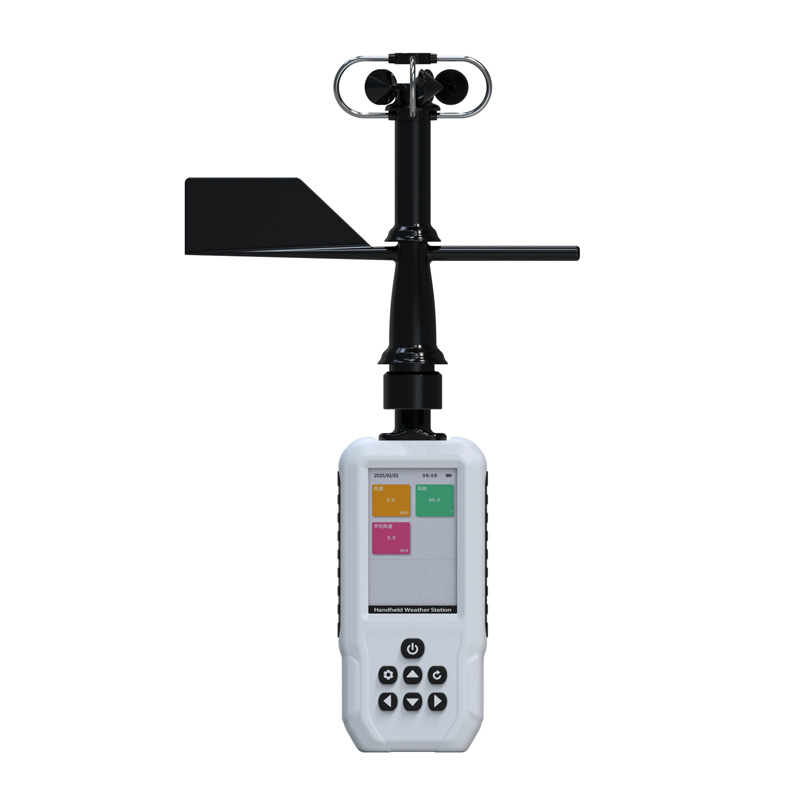
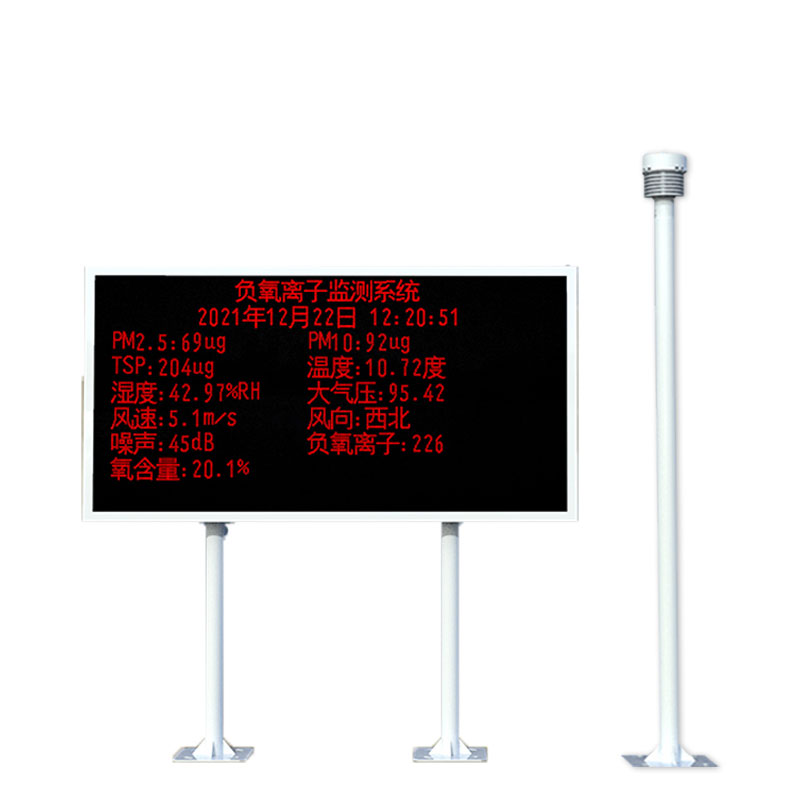
Park weather station can automatically collect data on the concentration of negative oxygen ions in the air around the clock, supporting extended data collection on multiple meteorological elements such as temperature, humidity, PM2.5, PM10, wind speed, and wind direction. Its modular design allows for individual sensor replacement, and data can be viewed on both an on-site LED screen and a remote cloud platform. It is widely applicable for air cleanliness assessment in tourist attractions, forest parks, and ecological parks.
Park weather station is a device specifically designed to measure the concentration of negative oxygen ions in ambient air, widely used in ecological locations such as tourist attractions, forest parks, wetland parks, and nature reserves. Negative oxygen ions are known as "air vitamins," and their concentration directly reflects air cleanliness and ecological health. Therefore, continuous and accurate monitoring of negative oxygen ion concentration has significant value for environmental assessment and tourism promotion.
Park weather station possesses all-weather automatic monitoring capabilities, enabling unattended 24-hour continuous data collection of negative oxygen ion concentration in the air. The data collection interval is at the millisecond level, ensuring rapid response and enabling continuous tracking and recording of negative oxygen ion concentration changes at each monitoring point. The system employs the internationally recognized "inhalation capacitive sensing method" to measure atmospheric negative ion concentration. The accompanying monitoring system software enables data reception, analysis, statistics, querying, curve analysis, and web publishing.
Park weather station's modular design is a significant technological advantage. Sensors can be individually replaced, allowing users to flexibly configure and expand monitoring items according to their specific needs. The basic monitoring item is negative oxygen ion concentration, and it can also be expanded to monitor various meteorological elements such as air temperature, humidity, PM2.5, PM10, atmospheric pressure, oxygen content, noise, wind speed, and wind direction. Comprehensive monitoring of multiple elements provides more comprehensive data support for air quality assessment, helping environmental protection departments and scenic area managers to more accurately understand the regional environmental conditions.
In terms of data display and access, Park weather station offers multiple convenient viewing methods. On-site, professional mounting brackets and LED screens are provided for direct reading of real-time monitoring data. Simultaneously, data can be wirelessly uploaded to a cloud platform in real time, allowing users to remotely view the data via a web interface or WeChat official account. The cloud platform supports multi-terminal access and features anomaly warning and remote calibration functions. In the event of system communication interruption, data can be cached locally and automatically re-uploaded upon recovery to ensure data integrity.
Park weather station has shown particularly outstanding effects in tourist attractions. Meteorological bureaus across the country have established negative oxygen ion monitoring stations within scenic areas, effectively supporting the creation of the "natural oxygen bar" brand and the revitalization of the all-area tourism industry by publishing real-time negative oxygen ion concentration data. The data is simultaneously displayed on LED color screens, allowing tourists and citizens to directly view the scenic area's air quality indicators, providing intuitive data evidence for health and wellness tourism.
Sales Manager:Ms. Emily Wang
Tel, Whatsapp:+86 15898932201
Email:info@fengtutec.com
Add:No. 155 Optoelectronic Industry Accelerator, Gaoxin District, Weifang, Shandong, China