Meteorological environment monitoring equipment supplier
Insist on doing high-precision customer favorite technology products

Meteorological environment monitoring equipment supplier
Insist on doing high-precision customer favorite technology products

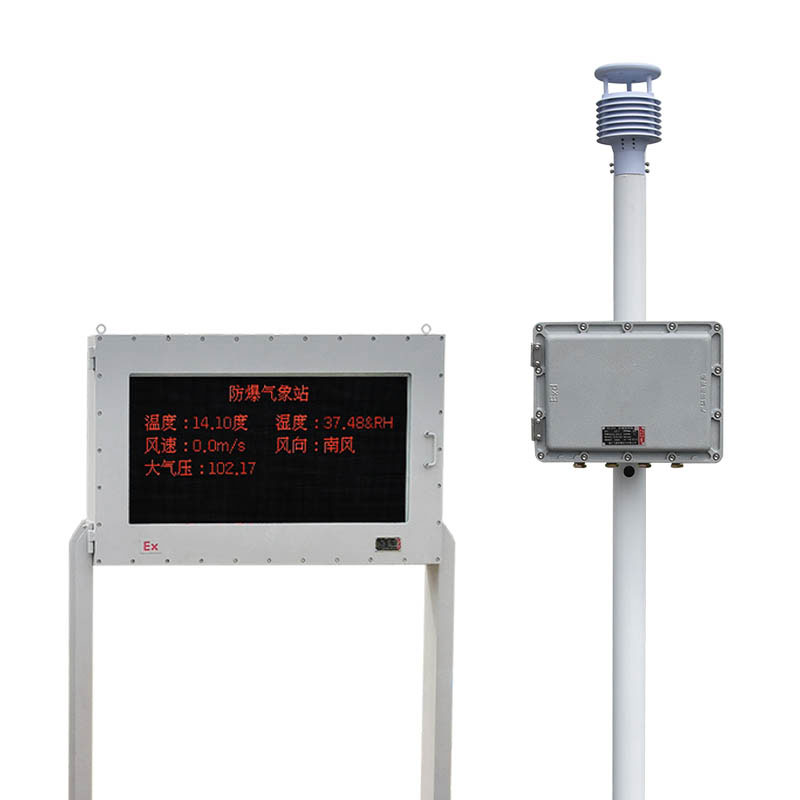
The Explosion-Proof Integrated Weather Station is a unified sensor system designed specifically for high-risk environments—such as chemical industrial parks and oil storage tank farms—that integrates monitoring capabilities for five key meteorological parameters: wind speed, wind direction, temperature, humidity, and atmospheric pressure.
Meteorological monitoring in chemical plants and oil depots has long faced safety challenges posed by the presence of flammable and explosive gases. Against this backdrop, the Explosion-Proof Integrated Weather Station—a monitoring device engineered specifically for hazardous locations—is gradually replacing traditional, distributed sensor arrays to become the industry's preferred standard. These devices employ an intrinsically safe, explosion-proof design that consolidates the monitoring of five meteorological elements—wind speed, wind direction, air temperature, humidity, and atmospheric pressure—into a single sensor unit, thereby effectively eliminating the safety hazards associated with the complex wiring schemes required by traditional multi-sensor setups.
From a technical standpoint, the Explosion-Proof Integrated Weather Station utilizes ultrasonic principles to measure wind speed and direction; it calculates wind speed by emitting continuous variable-frequency signals and detecting the resulting phase shifts. The device features a top-cover-concealed probe design, which effectively resolves issues related to the accumulation of rain and snow, as well as wind obstruction caused by the sensor housing itself. Temperature is measured using the diode junction voltage method, humidity is monitored via capacitive sensors, and atmospheric pressure data is acquired using piezoresistive sensors. All measured data is processed in real-time by an internal microprocessor and subsequently outputted as a unified data stream via an RS485 digital interface.
The core safety protection system of the Explosion-Proof Integrated Weather Station is built upon a foundation of multi-layered safety designs. The device's housing is constructed from ASA—a corrosion-resistant material—and boasts "five-proof" capabilities: water-proofing, explosion-proofing, dust-proofing, shock-proofing, and corrosion-proofing. This robust construction ensures stable operation in explosive gaseous environments, such as those surrounding chemical reactors, within oil storage tank farms, and at gas stations. The product has received certification from the National Quality Supervision and Inspection Center for Explosion-Proof Electrical Products; its explosion-proof enclosure completely seals off the internal circuitry, thereby preventing any electrical sparks from propagating outward.
Regarding data transmission, the Explosion-Proof Integrated Weather Station integrates data acquisition, storage, display, and communication functions into a single unit. It utilizes wired communication channels to directly transmit meteorological data to explosion-proof display screens for real-time visualization, while simultaneously supporting integration with the PLC or DCS systems located in central control rooms for comprehensive data processing and analysis. The device is compatible with the standard Modbus-RTU protocol and maintains power consumption below 2W, enabling continuous operation for over 30 days to facilitate 24-hour, real-time online monitoring of outdoor meteorological parameters. Its compact, integrated design ensures a simple and convenient installation and removal process, making it widely applicable in outdoor environments requiring explosion-proof certification—such as gas wells, oil storage tanks, pipelines, tunnels, and mines. The enclosure, utilizing positive-pressure purging technology, isolates toxic and hazardous gases from the interior, thereby further guaranteeing the device's stable operation under extreme working conditions and providing precise, reliable environmental data support for safe production in high-risk areas.
Sales Manager:Ms. Emily Wang
Tel, Whatsapp:+86 15898932201
Email:info@fengtutec.com
Add:No. 155 Optoelectronic Industry Accelerator, Gaoxin District, Weifang, Shandong, China