Meteorological environment monitoring equipment supplier
Insist on doing high-precision customer favorite technology products

Meteorological environment monitoring equipment supplier
Insist on doing high-precision customer favorite technology products

Highway meteorological observation stations integrate a variety of sensors to continuously monitor visibility, temperature, humidity, wind speed and direction, atmospheric pressure, precipitation, and road surface conditions. Powered by solar energy or the mains grid, these stations transmit data remotely via 4G, providing traffic management authorities with real-time meteorological monitoring information.
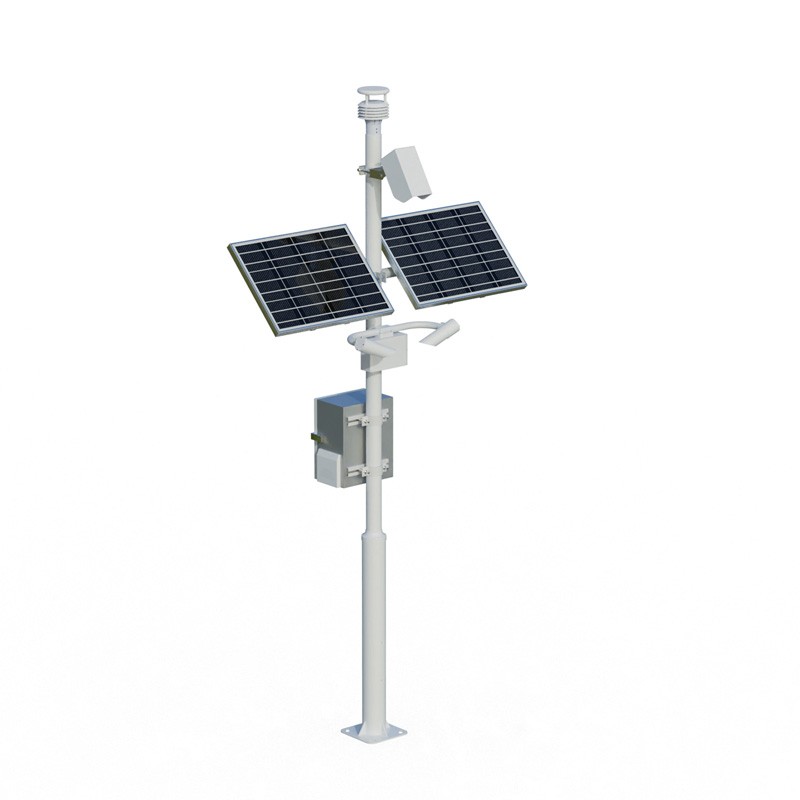
Leveraging data acquisition and control systems, specialized software, and communication technologies, these stations integrate various meteorological sensors to continuously collect data along highways, serving as a foundational monitoring resource for traffic-related weather support. The complete system—comprising visibility sensors, remote road-surface condition sensors, multi-parameter weather sensors, data loggers, mounting masts, power supply systems, and a cloud platform—can be deployed at critical locations such as expressways, national highways, and bridges to conduct all-weather, on-site monitoring.
These stations simultaneously capture key meteorological parameters, including visibility, wind speed and direction, air temperature, humidity, atmospheric pressure, precipitation, and road surface conditions. The visibility sensor utilizes the principle of aerosol forward-scattering: it detects atmospheric particles via infrared light pulses and applies algorithms to calculate the meteorological optical range. An integrated multi-parameter sensor module combines temperature, humidity, atmospheric pressure, and piezoelectric precipitation monitoring. The ultrasonic wind sensor features a shielded design to minimize measurement errors caused by the accumulation of rain or snow, as well as airflow obstruction. The piezoelectric precipitation sensor employs a PVDF (polyvinylidene fluoride) film and embedded AI algorithms to identify raindrop signals, effectively reducing false triggers caused by dust or vibrations. Road surface conditions are monitored via non-contact infrared remote sensing, which detects whether the road is dry, wet, icy, or snow-covered without requiring any structural alteration to the road surface.
Equipped with a 4G wireless transmission module as a standard feature, these stations aggregate on-site monitoring data and upload it in real-time to a cloud platform, from where it is simultaneously relayed to traffic management authorities. The power supply system supports both solar and grid-based power, allowing for flexible selection based on on-site conditions—an ideal solution for long-term, stable operation in remote areas lacking access to the power grid. Each monitoring parameter comes with clearly defined measurement ranges and accuracy specifications: visibility can be measured from 5 meters to 10 kilometers, wind speeds up to 60 m/s, and temperatures from -40°C to 60°C—a configuration that meets the long-term monitoring requirements for highways across most regions of China.
By leveraging continuous data from these highway meteorological observation stations, traffic management authorities can track real-time weather changes along specific road sections. This enables the proactive implementation of control measures in response to risks such as localized dense fog, heavy rainfall, or icy road surfaces, thereby reducing traffic accidents caused by adverse weather. Furthermore, authorities can disseminate weather-related travel information to the public, further enhancing safety and security on the highway network.
Sales Manager:Ms. Emily Wang
Tel, Whatsapp:+86 15898932201
Email:info@fengtutec.com
Add:No. 155 Optoelectronic Industry Accelerator, Gaoxin District, Weifang, Shandong, China