Meteorological environment monitoring equipment supplier
Insist on doing high-precision customer favorite technology products

Meteorological environment monitoring equipment supplier
Insist on doing high-precision customer favorite technology products

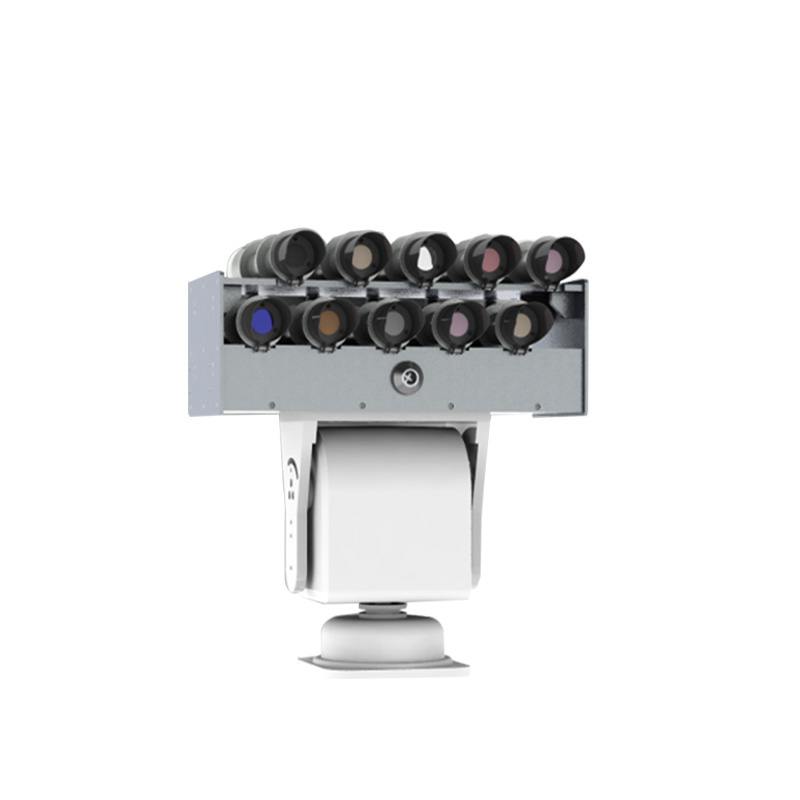
The Spectrometer is an intelligent solar spectroradiometer that uses a combination of multispectral filters and a thermopile to measure radiant energy in different spectral ranges. This instrument can observe direct radiation data in 10 bands, while simultaneously monitoring total solar radiation, scattered radiation, reflected radiation, ultraviolet radiation, photosynthetic radiation, and net total radiation. The equipment is widely used in agriculture, energy, building materials, and aerospace, achieving precise measurement of solar spectral energy through high-precision spectroscopic technology.
The Spectrometer is a professional device capable of continuously acquiring solar radiation data in long-term, unattended operation in the field. The instrument mainly consists of three parts: an optical head, a control box, and a dual-axis stepper motor system. The motor system controls the azimuth and pitch angles of the optical head, achieving precise tracking of the sun's position. In the optical head, multispectral filters decompose sunlight into spectral components of different wavelengths, while thermopile sensors convert light energy into measurable electrical signals, enabling simultaneous acquisition of radiant energy across multiple bands from ultraviolet to near-infrared. The FT-GD1 is typically configured with 10 observation bands, covering wavelengths from 280 nm to 1640 nm, encompassing the main spectral regions of visible and near-infrared light.
At the application level, the versatility of the instrument allows it to serve the technical needs of multiple industries. In environmental monitoring, the instrument calculates atmospheric aerosol optical thickness, water vapor content, and ozone concentration by measuring solar and sky radiance, providing fundamental data for air quality and climate research. In agriculture, real-time monitoring of photosynthetic radiation and ultraviolet radiation helps assess the light conditions of crop growth environments. In the energy sector, observational data on total solar radiation, diffuse radiation, and direct radiation are crucial for photovoltaic power plant site selection assessments and power generation efficiency analysis. In aerospace, the radiation correction data provided by the instrument can be used for satellite sensor calibration and remote sensing product verification.
From a technological perspective, the automatic tracking system of Spectrometer is a key feature that distinguishes it from traditional handheld radiometric measurement devices. The dual-axis stepper motor system uses a time equation to perform initial solar tracking, followed by precise calibration by a four-quadrant detector system, achieving a tracking accuracy better than 0.1 degrees. In fully automatic measurement mode, the device's attached humidity sensor can detect rainfall, and the control box automatically shuts down the photometer to protect the optical system. Combined with a solar power module and wireless data transmission capabilities, the instrument can achieve long-term stable automatic operation in remote environments without external power. It is this comprehensive capability—high-precision automatic tracking, multispectral synchronous measurement, and long-term unattended operation in the field—that enables Spectrometer to play an irreplaceable role in fields such as climate change monitoring, atmospheric environment research, and satellite radiometric calibration.
Sales Manager:Ms. Emily Wang
Tel, Whatsapp:+86 15898932201
Email:info@fengtutec.com
Add:No. 155 Optoelectronic Industry Accelerator, Gaoxin District, Weifang, Shandong, China