Meteorological environment monitoring equipment supplier
Insist on doing high-precision customer favorite technology products

Meteorological environment monitoring equipment supplier
Insist on doing high-precision customer favorite technology products

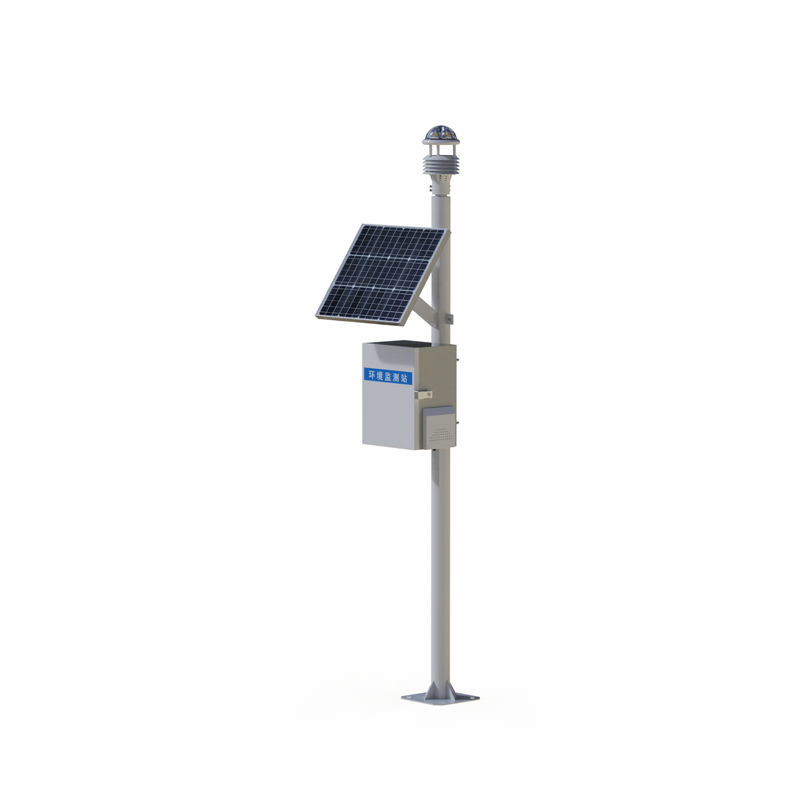
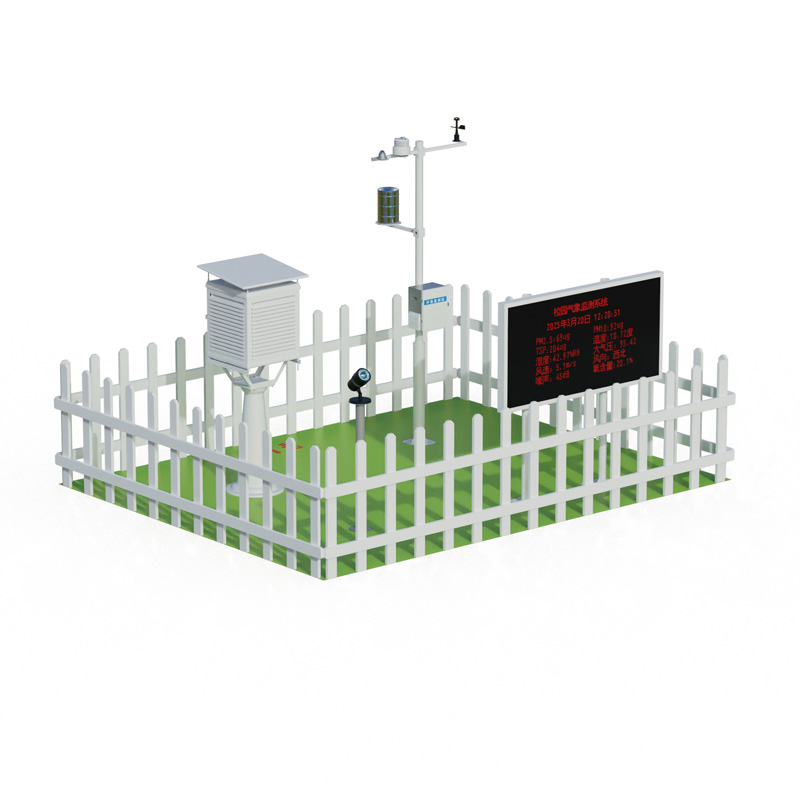
A school weather station system comprises a complete set of components: sensors, a pole mount, an equipment cabinet, an LED display, a data collector, a cloud platform, and a protective enclosure. Housed within a fiberglass Stevenson screen—which itself contains a dry-and-wet bulb thermometer and a sunshine recorder—the system collectively monitors various meteorological elements, including atmospheric pressure, wind speed and direction, temperature, humidity, and rainfall.
The hardware architecture of the school weather station primarily consists of nine key components: sensors, a pole mount, an equipment cabinet, an LED display, a data collector, a cloud platform, a fiberglass Stevenson screen, a sunshine recorder, and a protective enclosure. Notably, the fiberglass Stevenson screen houses a dry-and-wet bulb thermometer, specifically designed to ensure the accurate measurement of temperature and humidity. This comprehensive system is capable of simultaneously monitoring multiple meteorological parameters—such as atmospheric pressure, wind speed, wind direction, temperature, humidity, and rainfall—thereby fulfilling the fundamental requirements for campus meteorological observation and educational practice.
Sensors constitute the core of the weather station, tasked with collecting raw data regarding meteorological elements such as atmospheric pressure, wind speed, wind direction, temperature, humidity, and rainfall. Different types of sensors are mounted at varying heights along the pole mount; specifically, the wind speed and direction sensors are typically positioned at the very top of the mount to facilitate the observation of wind dynamics across the campus. The data collector is responsible for receiving and processing the data transmitted by the sensors, subsequently transmitting this information—via either wired or wireless connections—to the cloud platform for storage and analysis.
The pole mount serves as the physical support structure for the weather station, providing the mounting base for all sensors and associated equipment. An equipment cabinet is positioned midway up the pole mount; this cabinet houses critical electronic components—including the data collector, power supply module, and communication module—and functions as a protective enclosure, shielding the internal hardware from water ingress and dust accumulation. An LED display is typically mounted on the side of the pole mount to provide real-time visualization of current meteorological data, allowing students and faculty to access up-to-the-minute weather information at any time. Finally, a protective enclosure fence surrounds the perimeter of the weather station, serving the dual purpose of safeguarding the equipment against accidental physical impact while also establishing a secure, isolated zone.
The fiberglass Stevenson screen and the sunshine recorder represent two vital components for meteorological observation within the campus weather station. The Stevenson screen, housing a dry-and-wet bulb thermometer, is utilized to measure air temperature and humidity; its louvered structural design effectively blocks direct sunlight and prevents rainwater intrusion while simultaneously ensuring unimpeded airflow. The sunshine recorder is employed to measure the duration of sunshine, thereby assisting students in understanding the patterns and variations of solar radiation. The cloud platform serves as the data management hub for the entire system. Data uploaded to the platform by data collectors can be stored for the long term, enabling teachers and students to access historical data and plot meteorological trends at any time via computer or mobile device. This automated approach to data management ensures that meteorological observation is no longer confined to the classroom, but instead becomes a routine tool for students' interdisciplinary inquiry and scientific practice.
Sales Manager:Ms. Emily Wang
Tel, Whatsapp:+86 15898932201
Email:info@fengtutec.com
Add:No. 155 Optoelectronic Industry Accelerator, Gaoxin District, Weifang, Shandong, China