Meteorological environment monitoring equipment supplier
Insist on doing high-precision customer favorite technology products

Meteorological environment monitoring equipment supplier
Insist on doing high-precision customer favorite technology products

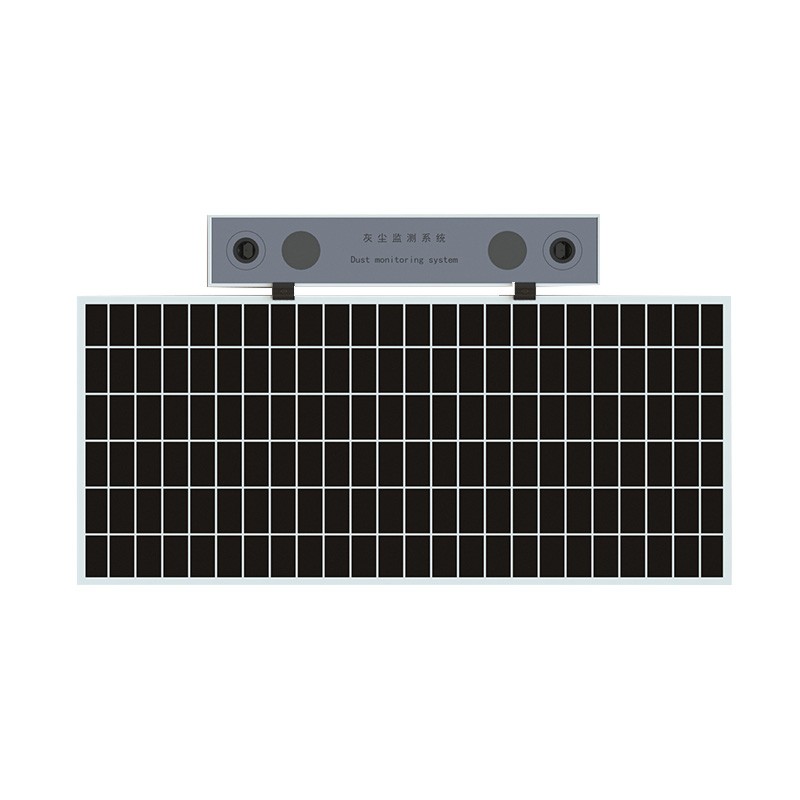
Photovoltaic module dust uses high-sensitivity sensors to monitor dust levels on photovoltaic (PV) panel surfaces in real time. Combined with analysis of contamination ratios and power generation losses, it helps maintenance personnel schedule cleaning promptly, improving power generation efficiency.
Photovoltaic module dust is a crucial monitoring device in PV power plant operation and maintenance, primarily used to detect the dust coverage on PV panel surfaces in real time. During long-term operation, PV panels are susceptible to dust, dirt, bird droppings, and other contaminants. These contaminants reduce glass transmittance, decreasing the effective energy of sunlight entering the battery modules, thus affecting PV power generation efficiency.
Traditional maintenance methods typically rely on manual inspections or periodic cleaning, which is not only inefficient but also difficult to accurately assess the actual contamination levels of PV panels in different areas. Especially in large PV power plants, modules in different locations may face varying degrees of dust accumulation. Cleaning according to a uniform cycle may result in untimely or excessive cleaning. Photovoltaic module dust can be installed on the PV panel frame to provide more accurate cleanliness data for the power plant by continuously monitoring changes in surface contamination.
The Photovoltaic module dust system is equipped with a high-sensitivity sensor that monitors dust levels on photovoltaic (PV) panels and converts the contamination rate into power generation loss information. When contaminants accumulate to a certain level, the system alerts maintenance personnel to perform timely cleaning, thereby reducing energy loss caused by dust accumulation. Compared to traditional detection methods, it enables real-time monitoring and remote surveillance, allowing managers to better understand the operating status of PV modules.
In practical applications, Photovoltaic module dust can be integrated into power plant management systems, helping users to view data from multiple monitoring points uniformly. System data can be used to determine cleaning timing and provide a reference for subsequent maintenance plans. This not only helps improve the cleanliness management of PV panels but also reduces unnecessary manual inspection costs.
For large-scale PV power plants, due to differences in contamination rates in different areas of the plant, single-point detection often fails to reflect the overall situation. Photovoltaic module dust supports multi-point monitoring, enabling the acquisition of more representative data based on actual environmental conditions. Its installation is relatively simple and can be applied to newly built PV arrays or retrofitted into existing power plants.
Overall, Photovoltaic module dust helps photovoltaic power plants schedule cleaning and maintenance more rationally through real-time monitoring, remote alerts, and data-driven management. It provides effective early warnings before dust affects power generation efficiency, reducing energy loss, improving power plant operating efficiency, and extending the lifespan of the photovoltaic system.
Sales Manager:Ms. Emily Wang
Tel, Whatsapp:+86 15898932201
Email:info@fengtutec.com
Add:No. 155 Optoelectronic Industry Accelerator, Gaoxin District, Weifang, Shandong, China