Meteorological environment monitoring equipment supplier
Insist on doing high-precision customer favorite technology products

Meteorological environment monitoring equipment supplier
Insist on doing high-precision customer favorite technology products

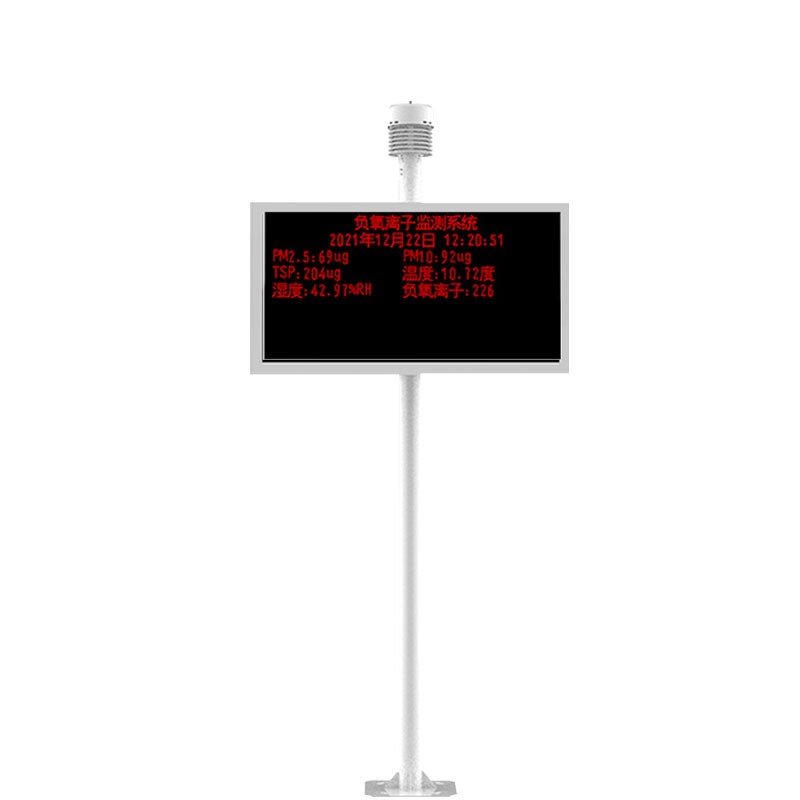
Small-scale weather stations equipped with LED displays are monitoring systems that integrate sensor-based data collection with outdoor visual presentation. They are primarily designed for use in scenic areas, parks, and ecological zones. Their core function is to monitor the concentration of negative oxygen ions in the air, with the capacity to also track parameters such as temperature, humidity, PM2.5, and PM10 levels. Featuring a modular design, the units allow for the individual replacement of sensors. Real-time readings are shown directly on an on-site LED screen, while data is simultaneously uploaded to a cloud platform or a WeChat-based interface, ensuring ease of operation and maintenance.
Technical specifications for these stations are highly consistent across various product offerings. Negative oxygen ion measurement utilizes a cylindrical electrode aspiration method, with a range of 0 to 100,000 ions per cubic centimeter, a resolution of 1 ion/cm³, and an accuracy of ±10%. Temperature is measured using the diode junction voltage method, covering a range of -40°C to 60°C with an accuracy of ±0.3°C. Humidity is measured via a capacitive sensor, with a range of 0–100% RH and an accuracy of ±0.3% RH. Particulate matter (PM2.5 and PM10) is monitored using the light-scattering principle, with a range of 0 to 1,000 micrograms per cubic meter and a resolution of 1 microgram per cubic meter. Power options include 220V mains electricity or solar power; data transmission is supported via GPRS or 4G networks; and the LED screens are typically constructed from P10 single-color (red) display modules.
In practical application, the deployment of these stations is straightforward. They are mounted on poles at entrances or key scenic landmarks, allowing visitors to view current negative oxygen ion levels directly on the screen without needing to log into any external platform. At the Shizhu Mountain Scenic Area in Fuzhou, for instance, an electronic display—part of an "air freshness" monitoring station—shows data on negative oxygen ions, temperature, and humidity. Visitors have described this as a way to see the "sweetness" of the air at a glance. This immediate, visible presentation addresses the common issue where ecological data is monitored but remains imperceptible to the public—often because monitoring stations are located far from visitors, with data sent only to back-end systems. These public-facing screens bring the data back to the very location where it is being measured. The structural design of the equipment is tailored for long-term field operation. The mounting pole utilizes carbon steel flanged connections, engineered to withstand typhoons of up to Category 15 (on the Chinese scale), and is designed to function in ambient temperatures ranging from -40°C to 60°C. A modular architecture ensures that if a specific sensor fails, the entire unit does not need to be returned to the factory; the system can be restored simply by replacing the individual probe. The backend software supports the retrieval of historical data and trend analysis, with some manufacturers offering SMS-based threshold alerts. For operators, routine maintenance is straightforward—primarily involving the cleaning of sensor air intakes and checking the status of the display screen—requiring minimal technical expertise.
It should be noted that there is no unified, mandatory metrological standard for negative oxygen ion monitoring, and sensors from different manufacturers may exhibit varying degrees of long-term drift. When procuring such equipment, verifying the availability of third-party calibration certificates and ensuring the sensors can be easily sent for inspection is more meaningful than merely comparing nominal accuracy specifications. Furthermore, since particulate matter (PM) measurements can be affected by moisture in high-humidity outdoor environments, some products incorporate heating-based dehumidification modules—a feature worth confirming when selecting equipment for scenic areas in southern regions.
Overall, the value of small-scale weather stations equipped with LED displays lies in their ability to translate abstract ecological indicators into data that is easily understood by the general public. Rather than aiming for laboratory-grade precision, these systems provide continuous, intuitive, and virtually maintenance-free on-site information at an accessible cost, making them well-suited for locations where ecological and environmental quality data needs to be presented to the public.
Sales Manager:Ms. Emily Wang
Tel, Whatsapp:+86 15898932201
Email:info@fengtutec.com
Add:No. 155 Optoelectronic Industry Accelerator, Gaoxin District, Weifang, Shandong, China