Meteorological environment monitoring equipment supplier
Insist on doing high-precision customer favorite technology products

Meteorological environment monitoring equipment supplier
Insist on doing high-precision customer favorite technology products

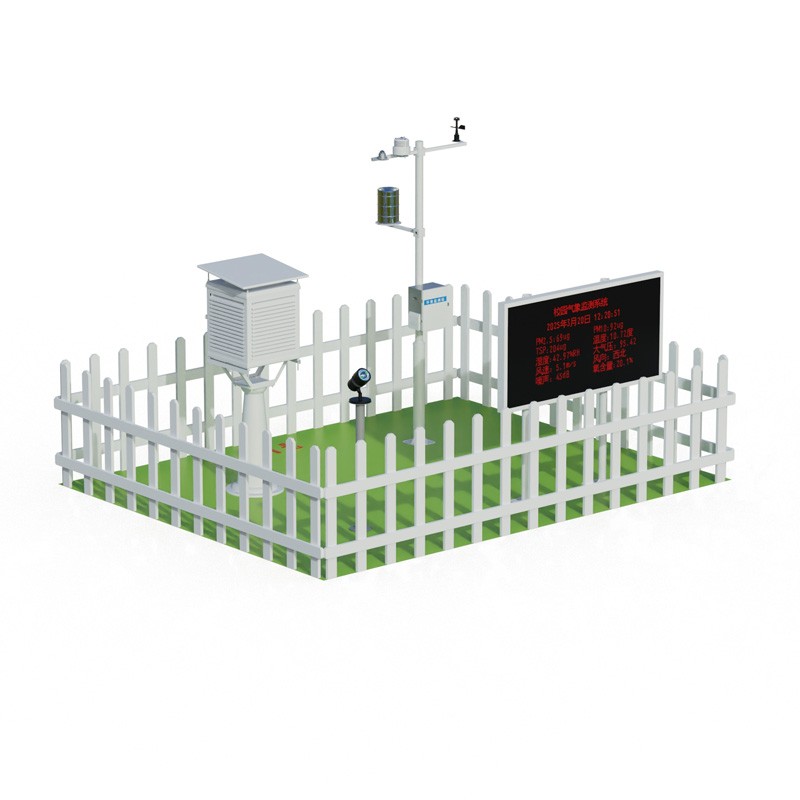
Designed for both teaching and scientific research, university campus weather stations are highly integrated, energy-efficient, and easy to install, allowing for rapid deployment across campus grounds. The system supports 4G wireless data transmission—with wired options available if needed—and operates on mains power, ensuring reliable, long-term continuous monitoring. For data visualization, the station includes a 2-meter by 1-meter LED screen that displays real-time meteorological data, making it easily accessible for students and faculty during daily use or classroom instruction.
The hardware configuration is specifically tailored to the needs of practical training. Sensors and mounting masts form the primary observation layer; an equipment enclosure houses data acquisition and processing units, while a cloud platform enables remote data storage and access. Notably, the station retains a traditional louvered screen (Stevenson screen) containing a psychrometer (wet- and dry-bulb thermometer). This allows students to grasp the fundamental principles of meteorological observation through manual readings, rather than relying solely on digital outputs from automated sensors. A sunshine recorder is also included to support instructional demonstrations and comparative observations. Furthermore, a perimeter fence physically separates the station from general campus activity areas, minimizing the risk of human interference with data quality.
The core value of these campus weather stations lies in their ability to integrate automated monitoring with manual observation. While automated sensors provide high-frequency, continuous data, the inclusion of a psychrometer and a sunshine recorder preserves the essential elements of hands-on operation and visual data collection. This approach elevates meteorological education beyond mere screen-based data browsing; students can actively participate in the observation process, gaining an understanding of how variables like temperature, humidity, and sunshine duration are measured—as well as the potential sources of error. The outdoor LED display also serves as an intuitive tool for campus-wide science outreach, allowing students and faculty to check current weather conditions without needing to log into a digital platform.
For universities, the implementation of such weather stations should also be aligned with curriculum requirements. Departments such as geography, environmental science, and atmospheric sciences can utilize these stations for practical fieldwork. By regularly recording and comparing automated data with manual observations, students can master the proper use of meteorological instruments and learn essential methods for data quality control. The standardized design of the equipment enclosure and data collector allows for the future addition of various sensor types; academic departments can incorporate sensors for soil temperature or solar radiation as required by their curricula, enabling the weather station to progressively adapt to the teaching plans of different semesters. Furthermore, the proper installation of perimeter fencing and mounting masts ensures both the security of the equipment within an open campus environment and the representativeness of the collected data.
Sales Manager:Ms. Emily Wang
Tel, Whatsapp:+86 15898932201
Email:info@fengtutec.com
Add:No. 155 Optoelectronic Industry Accelerator, Gaoxin District, Weifang, Shandong, China